September 2026 Spam Update Phase 3: A Third Wave Hits as the Two-Week Rollout Nears Its End

Contents
Google's September 2026 spam update is not behaving like a normal spam update. Rather than one sharp jolt that settles within a couple of days, it has arrived in three separate waves. The third ran from Saturday, October 4 to Monday, October 6, and it may be the last before Google marks the rollout complete.
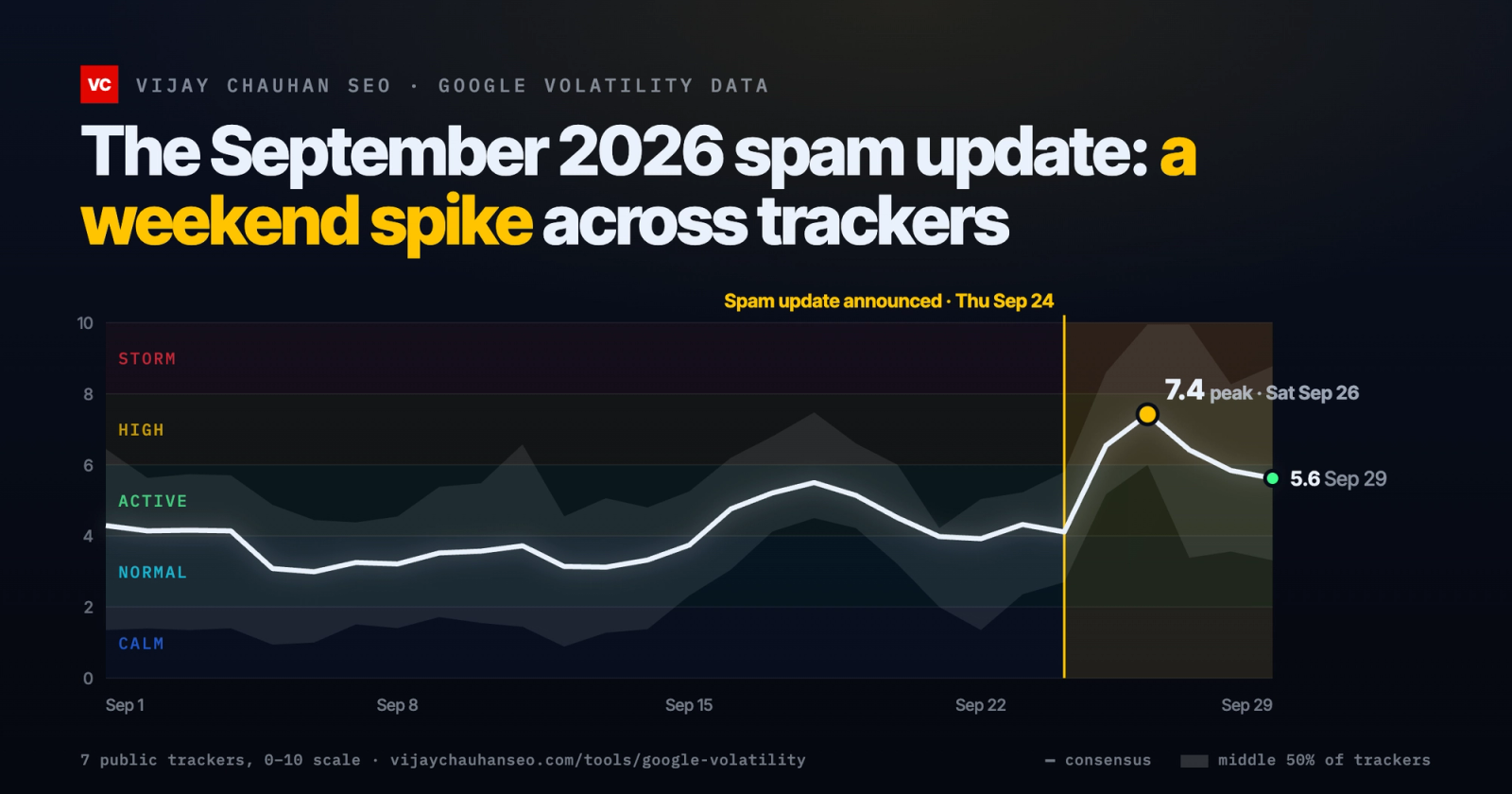
I covered the first wave last week in what 7 volatility trackers showed over the weekend. This post picks up where that one stopped. It covers what happened after the first weekend, how the third wave compares with the earlier two, and what to do if your traffic moved.
A quick recap: why this update was always going to be different
Google posted the update to its Search Status Dashboard on September 24, 2026, at 9:15 a.m. PT. It applies globally and in every language. The detail that stood out was the timeline: Google said the rollout "may take up to two weeks to complete."
That's unusual. The March, June and August spam updates this year were each expected to take "a few days". A two-week window suggested the update would not land all at once, and that is how it has played out. The impact has come in bursts on different days, with quieter days in between.
Google, as usual, hasn't said which spam tactics or types of site it is targeting. It's described as a normal spam update.
Three waves, one update
Here's how the rollout has unfolded so far, using the consensus score from my Google Search Volatility Aggregator, which combines public trackers into one 0–10 reading:
| Phase | Dates | Peak consensus | What stood out |
|---|---|---|---|
| Phase 1 | Sep 25–27 | 7.4 (Sep 26) | Broad agreement. Mozcast and AccuRanker both hit 10.0 |
| Phase 2 | Sep 30–Oct 1 | 6.3 (Oct 1) | Semrush Sensor jumped from 5.4 to 9.1 overnight |
| Lull | Oct 2–3 | 5.3 | Semrush fell back to 3.2 |
| Phase 3 | Oct 4–6 | 5.3 | Semrush climbed again, from 7.2 to 9.4 |
The first wave was the loudest by a distance. The second was shorter and narrower. The third is the most interesting, because its effect depends heavily on which tracker you look at.
Phase 3, day by day
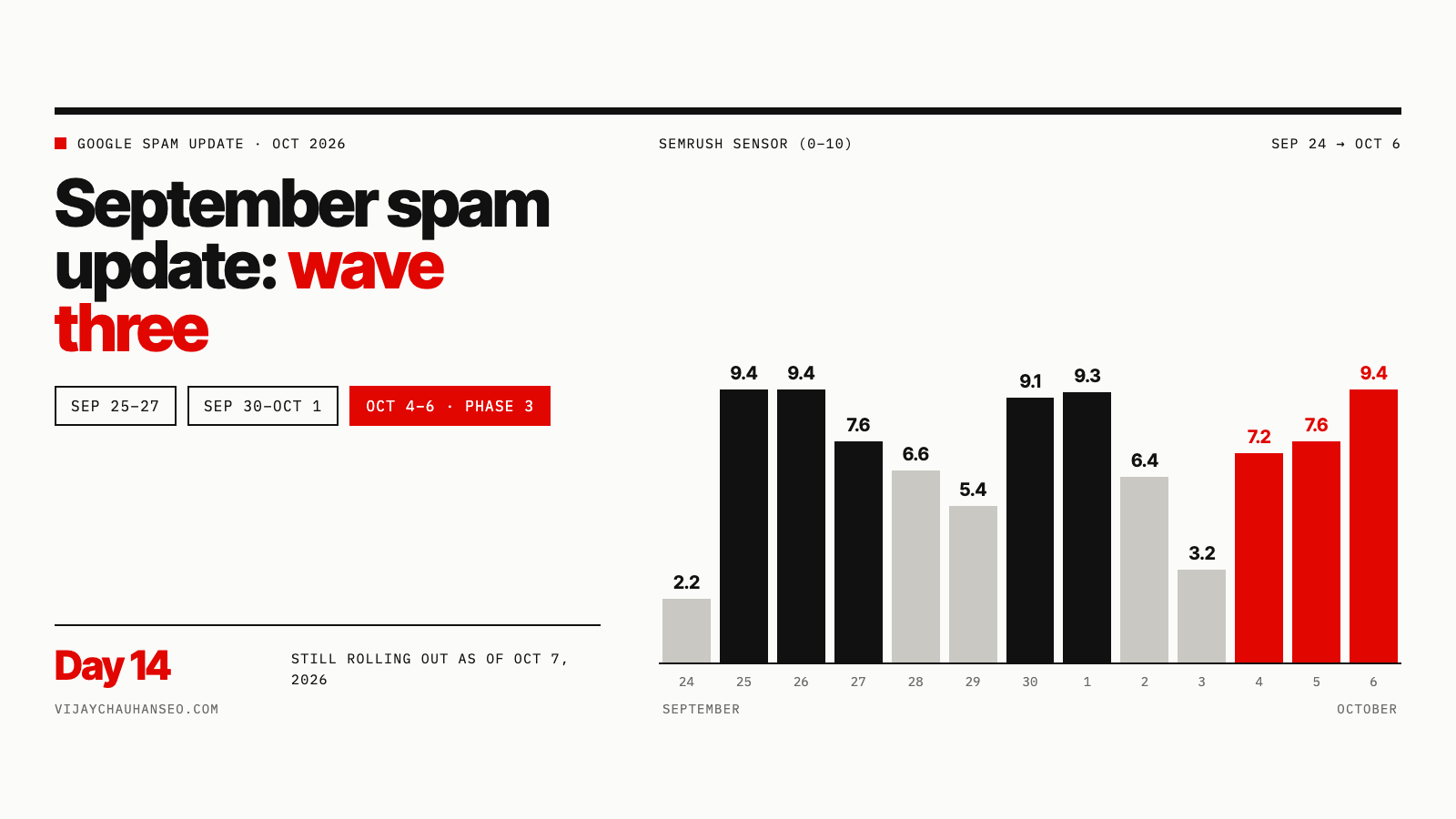
The clearest sign of a third wave came from Semrush Sensor. It had dropped to 3.2 on Friday, October 3, which looked like the update was winding down. Then it rose again:
- Saturday, Oct 4: 7.2
- Sunday, Oct 5: 7.6
- Monday, Oct 6: 9.4, matching its highest readings from the first weekend
Other trackers moved too, just less dramatically. Advanced Web Ranking edged up each day, from 3.8 to 4.8, its highest reading of the rollout. Algoroo, which barely reacted to the first two waves, reached 1.0 on October 6. That's still low on its own scale, but it's the highest it has been all month.
Search Engine Roundtable reported the same pattern across a wider set of tools, with Semrush, AWR, Mozcast, Wincher, Serpstat, AccuRanker and others showing more movement over the same days.
Why the consensus barely moved
If phase 3 was real, why did the consensus stay around 5? Two reasons.
First, Zutrix stopped pulling the average up. Zutrix Tension sat at 9.9 almost every day from September 25 to October 4. On October 5 it dropped to 6.7. With one of the loudest trackers cooling at the same moment Semrush was heating up, the two largely cancelled out.
Second, Mozcast went quiet. Mozcast has published no fresh data since September 30, so it's missing from the consensus for the whole third wave. During phase 1 it was at 10.0, so its absence drags the average down.
This is exactly why I don't trust a single number on its own during a spam update. Spam updates go after specific sites and tactics. They don't reshuffle every result. So a tracker whose keyword set happens to include affected sites goes into the red, while another that doesn't stays calm. A consensus of 5.3 with Semrush at 9.4 and Algoroo at 1.0 is not a "moderate" day. It's a targeted day.
At the time of writing, my tool shows 6.2 out of 10 (High), with only 2 of 6 live trackers within two points of the consensus. That low agreement is typical of a spam update, and it's the best clue that the movement is concentrated rather than broad.
What SEOs are saying
The reports on Search Engine Roundtable and in the comments there are mostly negative. Some site owners said the October 4–6 period felt like the update was either finishing or starting something new. Others said search traffic fell again.
A few things kept coming up:
- News publishers are hurting. One said their news site's earnings were down around 80%.
- Some Discover traffic is coming back. At least one publisher said Discover traffic was picking up again, which might mean some first-wave losses are reversing.
- Complaints about the results themselves. People mentioned more spam in the results, not less, and poor machine translations showing up in Google News.
Treat anecdotes like these carefully. People whose traffic dropped are always louder than those whose traffic grew. Still, the news-publisher complaints have appeared consistently since the first weekend.
Is the rollout over?
Not officially. As of October 7, Google's dashboard still lists the update as rolling out, now on day 14. The two-week window Google gave ends around now, so a completion notice should be close. But Google's estimates are a guide, not a deadline, and updates have run over before.
Phase 3 looks like the final push, but I wouldn't rule out another round of movement until Google marks the update complete.
What to do now
- Annotate every wave, not just the start date. Add September 24 (the announcement) to GA4 and your rank tracker, plus September 25–27, September 30 and October 4–6. If traffic changed, knowing which wave it lines up with tells you a lot more than "sometime in the last two weeks".
- Compare page groups, not the whole site. A spam update rarely hits a site evenly. In Search Console, compare clicks by folder or page type before and after each wave to find what actually changed.
- Check losing pages against Google's spam policies. Look for scaled content, site reputation abuse (third-party content riding on your domain's authority), expired-domain tactics and link schemes. If a section matches, that's where to look first.
- Don't make big changes yet. Migrations, template rewrites and mass deletions will make it impossible to tell your changes apart from Google's. Wait until the rollout is marked complete.
- Don't chase gains either. Pages that went up during one wave have dropped in the next in past updates. Wait a week or two after completion before deciding a change is permanent.
Keep watching the data
I'll keep tracking the rollout in the Google Search Volatility Aggregator. It pulls six live public trackers onto one 0–10 scale, highlights Google's confirmed updates on a 30-day chart, and shows how many trackers agree, which matters more than the headline number during a spam update. It refreshes every few hours and doesn't need a signup.
FAQ
When did the Google September 2026 spam update start?
Google announced it on September 24, 2026, and said the rollout could take up to two weeks. The first noticeable ranking changes came on September 25.
How many phases has the September 2026 spam update had?
Three so far: September 25–27, September 30 to October 1, and October 4–6. The first was the strongest. The third showed up most clearly in Semrush Sensor.
Is the September 2026 spam update finished?
Not yet. As of October 7, 2026, Google's Search Status Dashboard still says it is rolling out. The two-week window Google gave is ending, so a completion notice is likely soon.
Why do volatility trackers disagree during a spam update?
Spam updates target specific sites and tactics rather than reshuffling results across the board. Each tracker monitors different keywords, so one tracker can show a storm while another shows almost nothing. How many trackers agree tells you more than any single reading.
Sources: Search Engine Roundtable: September 2026 spam update phase 3 (Oct 6, 2026); Search Engine Roundtable: September 2026 spam update (Sep 24, 2026); Google Search Status Dashboard; Google Search Volatility Aggregator.
My free Google Search Volatility Aggregator combines the major public trackers into one 0–10 reading, flags confirmed updates, and shows how many trackers agree.
Check today’s volatility