September 2026 Spam Update Is Complete: 13.7 Days, Three Waves, and Longer Than Any 2026 Core Update

Contents
Google has finished rolling out the September 2026 spam update. The incident on the Google Search Status Dashboard was closed with an end time of 1:00 a.m. PT on Thursday, October 8, 2026, and Google Search Central confirmed it on X at 1:37 a.m. PT.
The rollout was complete as of October 8, 2026.
— Google Search Central (@googlesearchc) October 8, 2026
The update began on September 24 at 9:15 a.m. PT. From start to finish it took 13 days and 15 hours and 45 minutes, which uses up almost all of the "up to two weeks" Google allowed for it on launch day.
I followed this one as it happened, first in what 7 volatility trackers showed over the first weekend and then in the third wave on October 4–6. This is the final write-up: how long the rollout lasted against every other confirmed update of 2026, what the trackers recorded from the first day to the last, and what to do now that Google has called it done.
What Google confirmed
- Name: September 2026 spam update.
- Started: September 24, 2026, 9:15 a.m. PT (16:15 UTC).
- Finished: October 8, 2026, 1:00 a.m. PT, confirmed at 1:37 a.m. PT.
- Scope: global, every language.
- Type: Google's LinkedIn post called it "a normal spam update". It did not describe it as a link spam update and, as usual, didn't say which tactics it targeted or what share of queries it touched.
It's the fourth confirmed spam update of 2026, after March, June and August. You can see all of them next to the core and Discover updates in my Google algorithm updates history.
It ran longer than both core updates this year
This is the part I find most interesting. Spam updates are normally the quick ones. Using the start and end times Google published on its status dashboard, here is every confirmed ranking update of 2026:
| Update | Started (UTC) | Ended (UTC) | Length |
|---|---|---|---|
| March 2026 spam update | Mar 24, 19:00 | Mar 25, 14:30 | 19.5 hours |
| June 2026 spam update | Jun 24, 16:00 | Jun 26, 17:00 | 2.0 days |
| August 2026 spam update | Aug 18, 16:27 | Aug 21, 08:49 | 2.7 days |
| May 2026 core update | May 21, 15:40 | Jun 2, 12:40 | 11.9 days |
| March 2026 core update | Mar 27, 09:00 | Apr 8, 13:00 | 12.2 days |
| September 2026 spam update | Sep 24, 16:15 | Oct 8, 08:00 | 13.7 days |
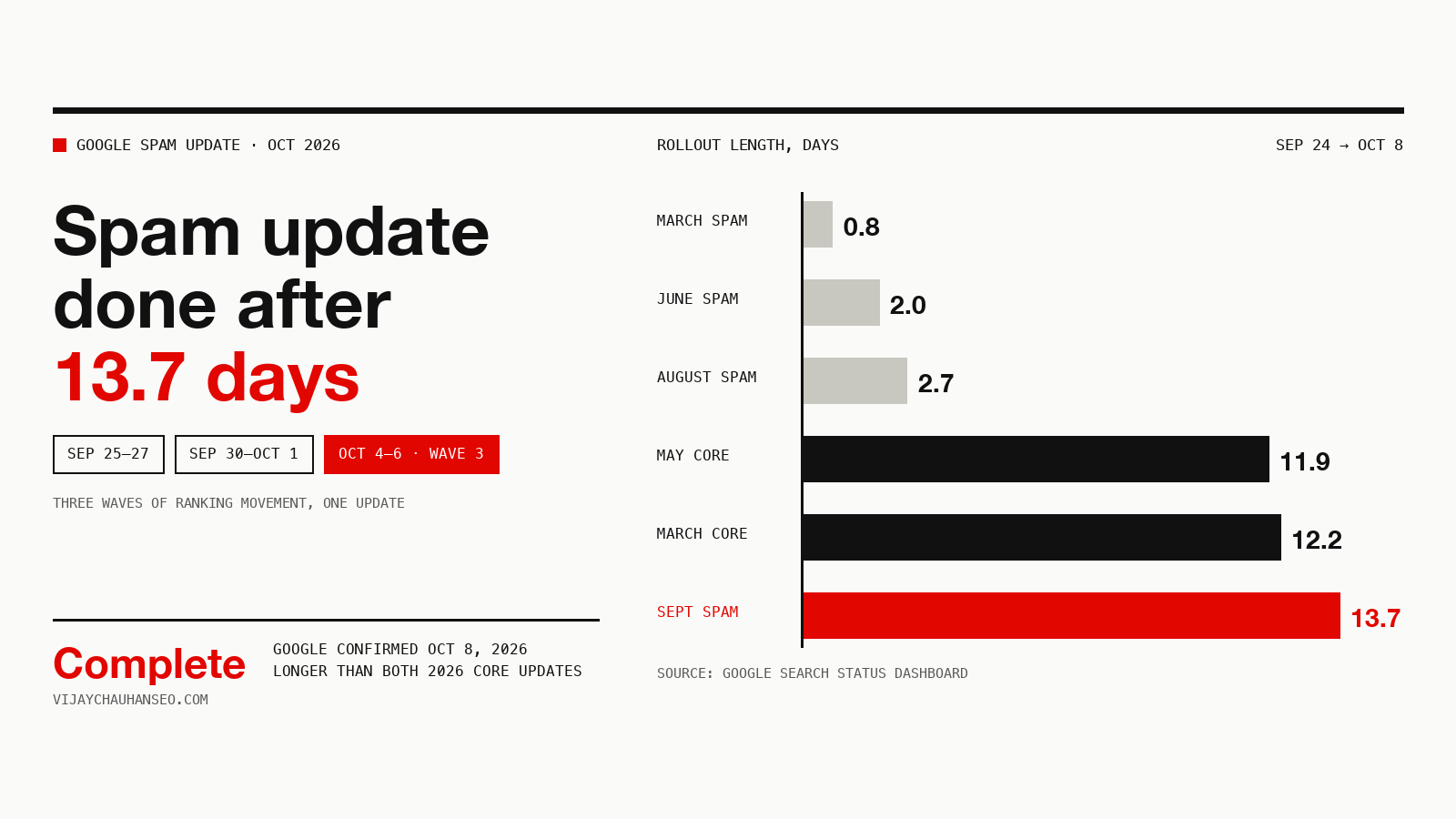
The three earlier spam updates this year took between 19.5 hours and 2.7 days. September took five times as long as August, and it also outlasted the March and May core updates.
Google hasn't explained why. My read is that a long rollout with separate bursts of movement looks more like several passes over different parts of the index than a single switch being flipped. That's an inference from the data, not something Google has said. Either way, it explains why so many people compared this update to a core update while it was happening.
The full rollout on one scale
These readings come from my Google Search Volatility Aggregator, which converts public trackers to a shared 0–10 scale (0–2 is calm, 8–10 is a storm). The consensus is the average of whichever trackers reported that day.
| Date | Consensus | Semrush | Zutrix | AWR |
|---|---|---|---|---|
| Sep 22 (baseline) | 3.7 | 1.0 | 5.7 | 3.0 |
| Sep 24 (launch) | 4.1 | 2.2 | 6.5 | 4.3 |
| Sep 25 | 6.5 | 9.4 | 9.9 | 3.2 |
| Sep 26 | 7.4 | 9.4 | 9.9 | 4.1 |
| Sep 27 | 6.4 | 7.6 | 9.9 | 3.4 |
| Sep 28 | 5.8 | 6.6 | 9.9 | 3.9 |
| Sep 29 | 5.5 | 5.4 | 9.9 | 3.6 |
| Sep 30 | 6.1 | 9.1 | 9.9 | 4.1 |
| Oct 1 | 6.3 | 9.3 | 9.9 | 4.4 |
| Oct 2 | 5.8 | 6.4 | 9.9 | 4.6 |
| Oct 3 | 5.3 | 3.2 | 9.9 | 3.8 |
| Oct 4 | 5.3 | 7.2 | 9.9 | 4.5 |
| Oct 5 | 4.9 | 7.6 | 6.7 | 4.7 |
| Oct 6 | 5.3 | 9.4 | 6.9 | 4.8 |
| Oct 7 | 5.4 | 9.4 | 7.5 | 5.2 |
| Oct 8 (complete) | 5.2 | 9.2 | 6.5 | 4.8 |
Three things stand out across the whole period:
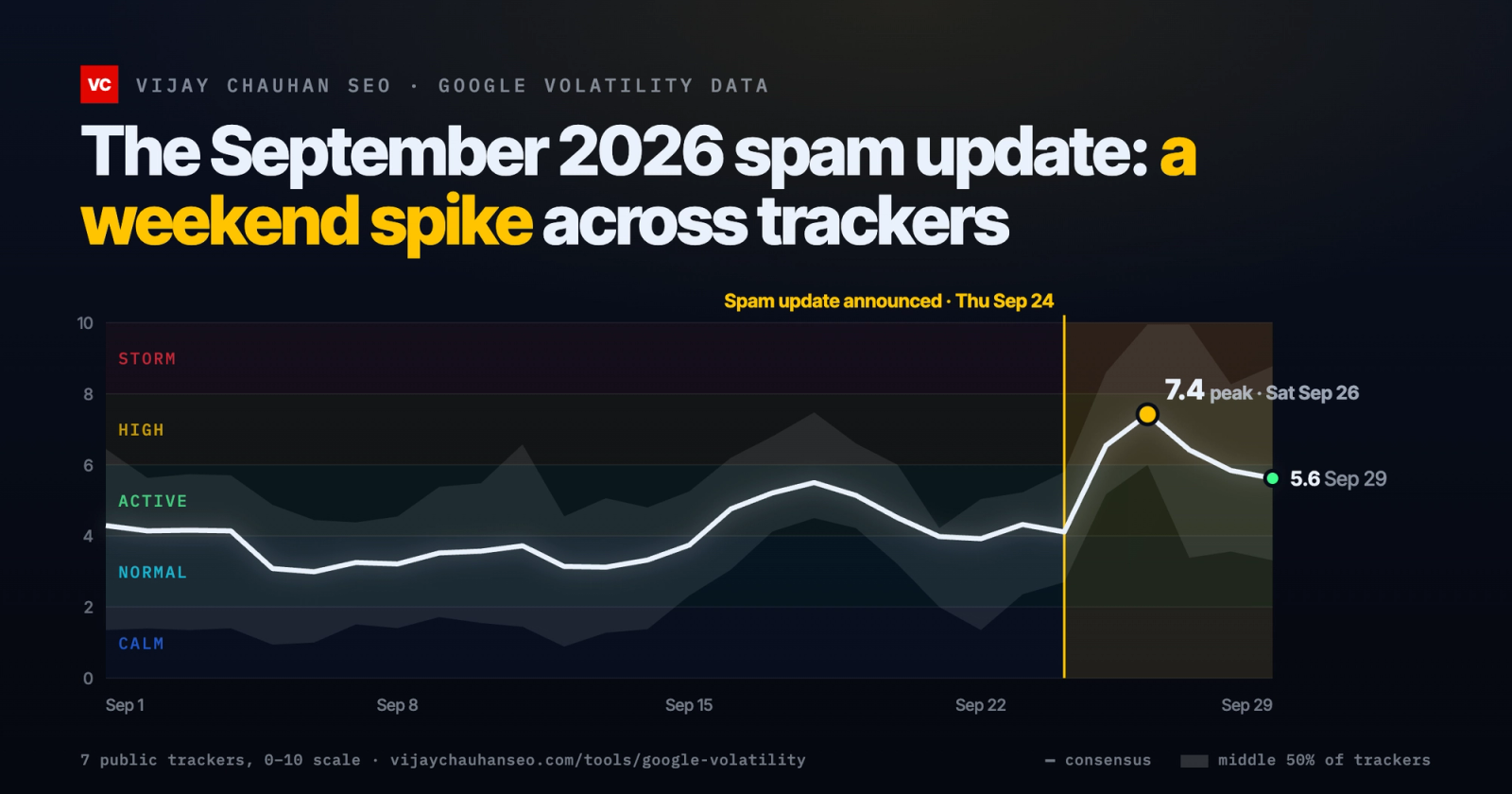
- The peak came early. The consensus topped out at 7.4 on Saturday, September 26, two days in. That day five of the seven trackers read 7.9 or higher.
- It never went back to baseline. Before the update the consensus sat between 3.7 and 4.1. It didn't fall below 4.9 on any day of the rollout.
- The last week was quieter overall but not for everyone. Semrush Sensor was at 9.2 or higher on October 6, 7 and 8, and Advanced Web Ranking hit its highest reading of the rollout (5.2) on October 7, the day before Google marked it complete. Algoroo never went above 1.0.
Mozcast stopped publishing new data after September 30, so it's missing from the consensus for the second half. It was reading 10.0 at the time, so the true average for October is probably a little higher than shown.
Three waves, one update
- Wave 1, Sep 25–27: the broad hit. Consensus 6.5, 7.4, 6.4. Mozcast and AccuRanker both maxed out.
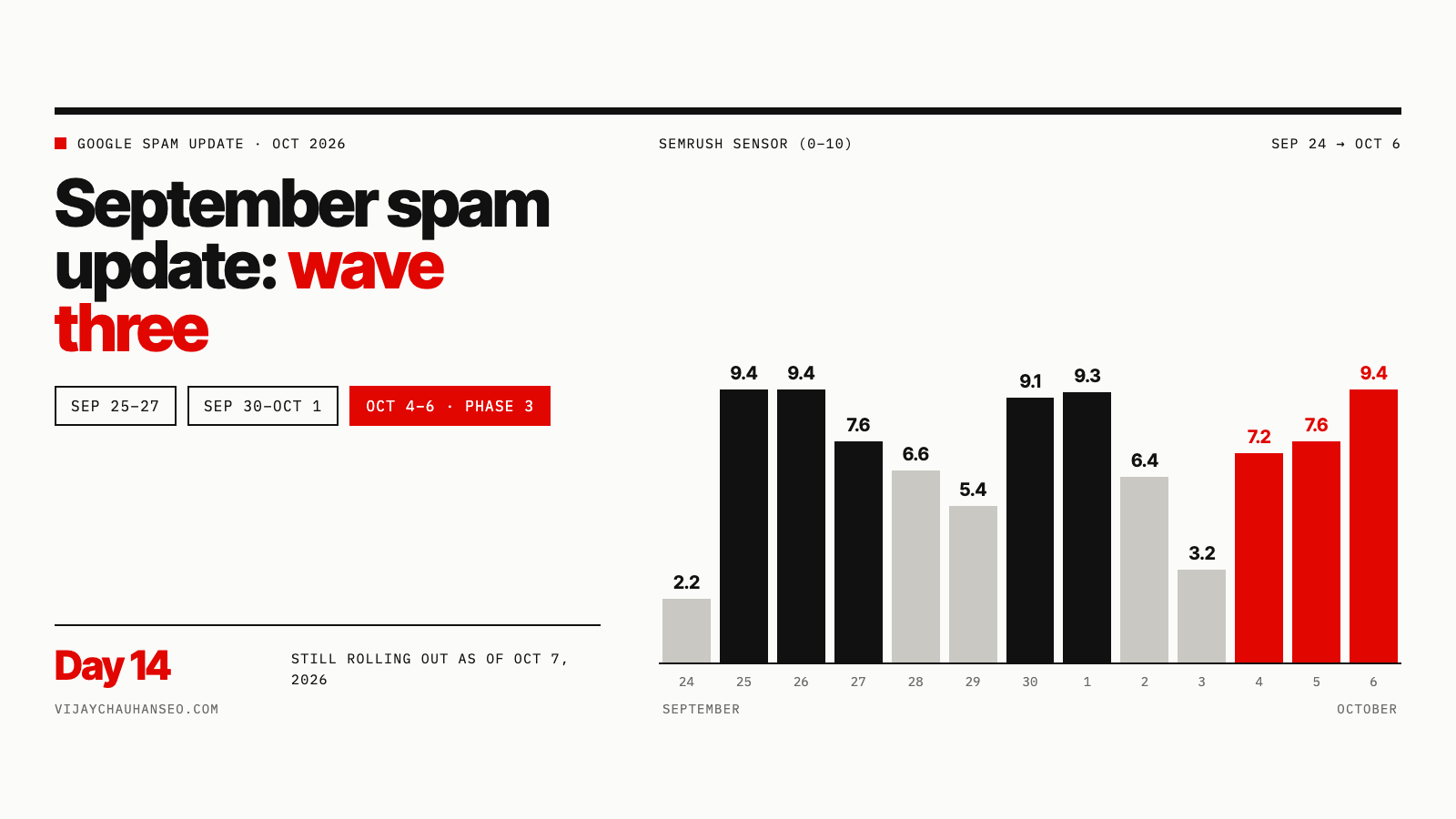
- Wave 2, Sep 30–Oct 1: narrower. Semrush jumped back to 9.1 and 9.3 after easing to 5.4.
- Wave 3, Oct 4–7: Semrush climbed from 3.2 to 9.4 and stayed there, while Zutrix cooled. The consensus barely moved because the two cancelled each other out.
A spam update targets particular sites and tactics, so it shows up hard on trackers whose keyword sets contain affected sites and barely at all on the rest. That's why the split between Semrush and Algoroo was so wide all the way through.
Complete doesn't mean settled
"Complete" means Google has finished rolling the update out. It doesn't mean rankings have stopped moving. On the completion date itself the consensus was still 5.2 and Semrush was still at 9.2, well above where things stood before September 24.
Give it until around October 15 before you judge where your site has landed. The dashboard shows no other confirmed ranking update overlapping this one, so if your traffic changed between September 25 and October 8, this update is the most likely cause.
What to do if your traffic dropped
- Match your drop to the waves. Open the Search Console Performance report, set the date range to September 15 – October 9 and look at daily clicks. A drop that starts on September 25, September 30 or October 4 lines up with one of the three waves.
- Check the Manual actions report. Spam updates are algorithmic and don't come with a notice. If you do have a manual action, it's a separate problem with its own fix and reconsideration request.
- Audit the affected pages against Google's [spam policies](https://developers.google.com/search/docs/essentials/spam-policies). The usual suspects are scaled content abuse (mass-produced pages, AI-generated or not, made mainly to rank), site reputation abuse (third-party content riding on your domain's authority), expired domain abuse, doorway pages and thin affiliate pages.
- Fix it and remove it, rather than waiting for the next update. Google's spam update documentation says improvements can help "if our automated systems learn over a period of months that the site complies with our spam policies." Recovery is slow, measured in months, not days.
- Don't disavow on reflex. Google didn't call this a link spam update. Disavowing links won't undo a hit for content-side spam, and it can remove links that were helping you.
If your traffic went up
A gain during a spam update usually means competitors above you lost ground, not that Google rewarded your site. Check which queries improved and which sites dropped out around you. Those positions can be volatile for a while, so it's a good moment to strengthen the pages that moved up.
My free Google Search Volatility Aggregator combines the major public trackers into one 0–10 reading, flags confirmed updates, and shows how many trackers agree.
Check today’s volatility