September 2026 Spam Update: What 7 Volatility Trackers Showed Over the Weekend

Contents
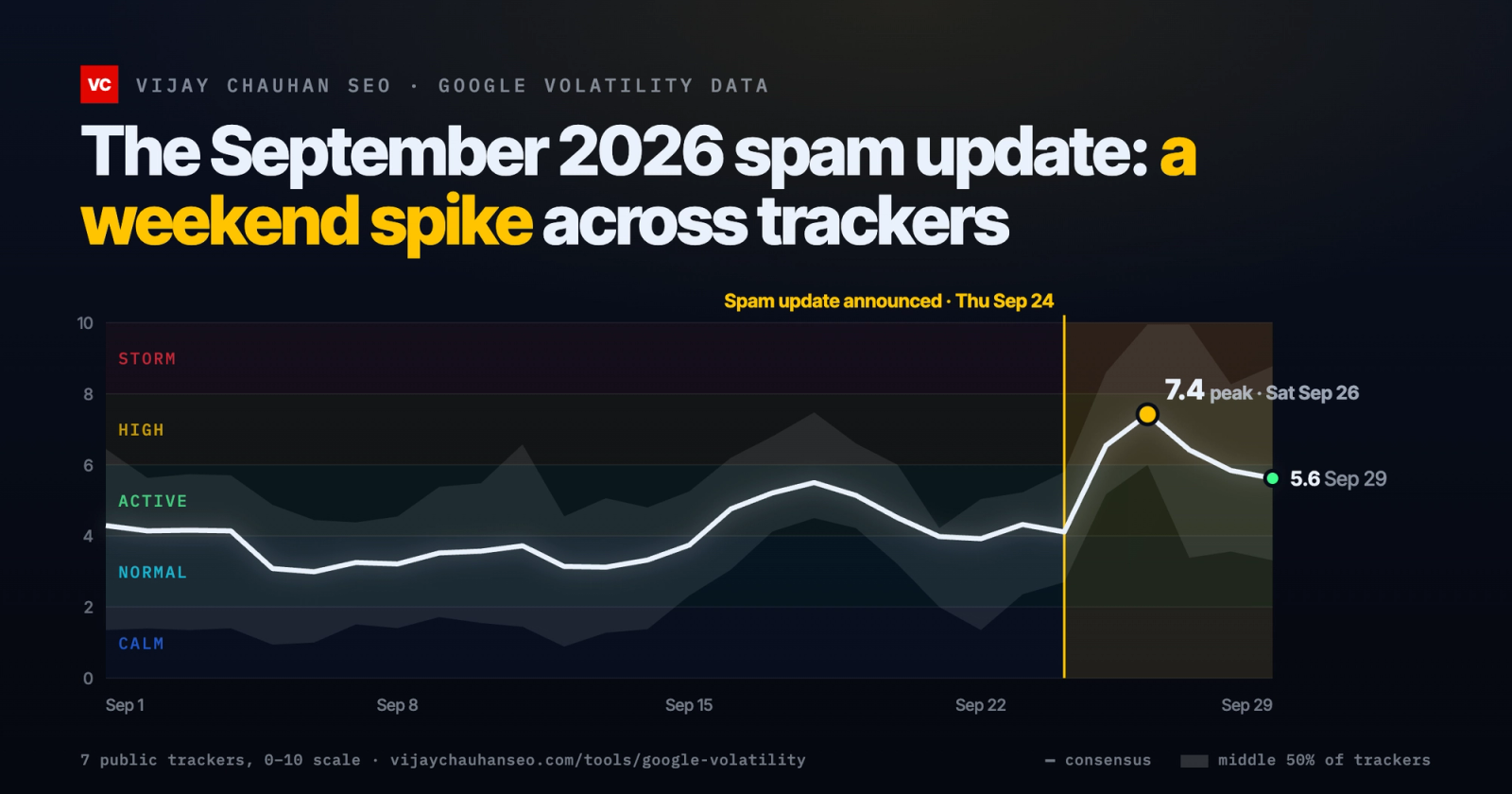
Google started rolling out the September 2026 spam update on Thursday, September 24. Rankings barely moved that day. The real movement came over the weekend: across the seven public trackers in my Google volatility tracker, the consensus jumped from 4.1 to 6.5 on Friday and peaked at 7.4 out of 10 on Saturday, September 26, well into "High" territory.
Most coverage of an update like this means scrolling through a dozen separate tracker screenshots, each on its own scale. Here is the same weekend on one scale, day by day, including the part most write-ups skip: two trackers barely reacted at all.
What Google announced
Google posted the update on its Search Status Dashboard at 16:15 UTC on September 24 (12:15 pm ET). It applies globally and to all languages, and Google said the rollout "may take up to two weeks to complete." That puts the likely finish around October 8. It is the fourth confirmed spam update of 2026, after March, June and August. You can see how it fits with the rest of the year in my Google algorithm updates history.
Spam updates are aimed at sites that break Google's spam policies, not at re-ranking the whole index the way a core update does. Keep that in mind when you read the data below.
The weekend spike, day by day
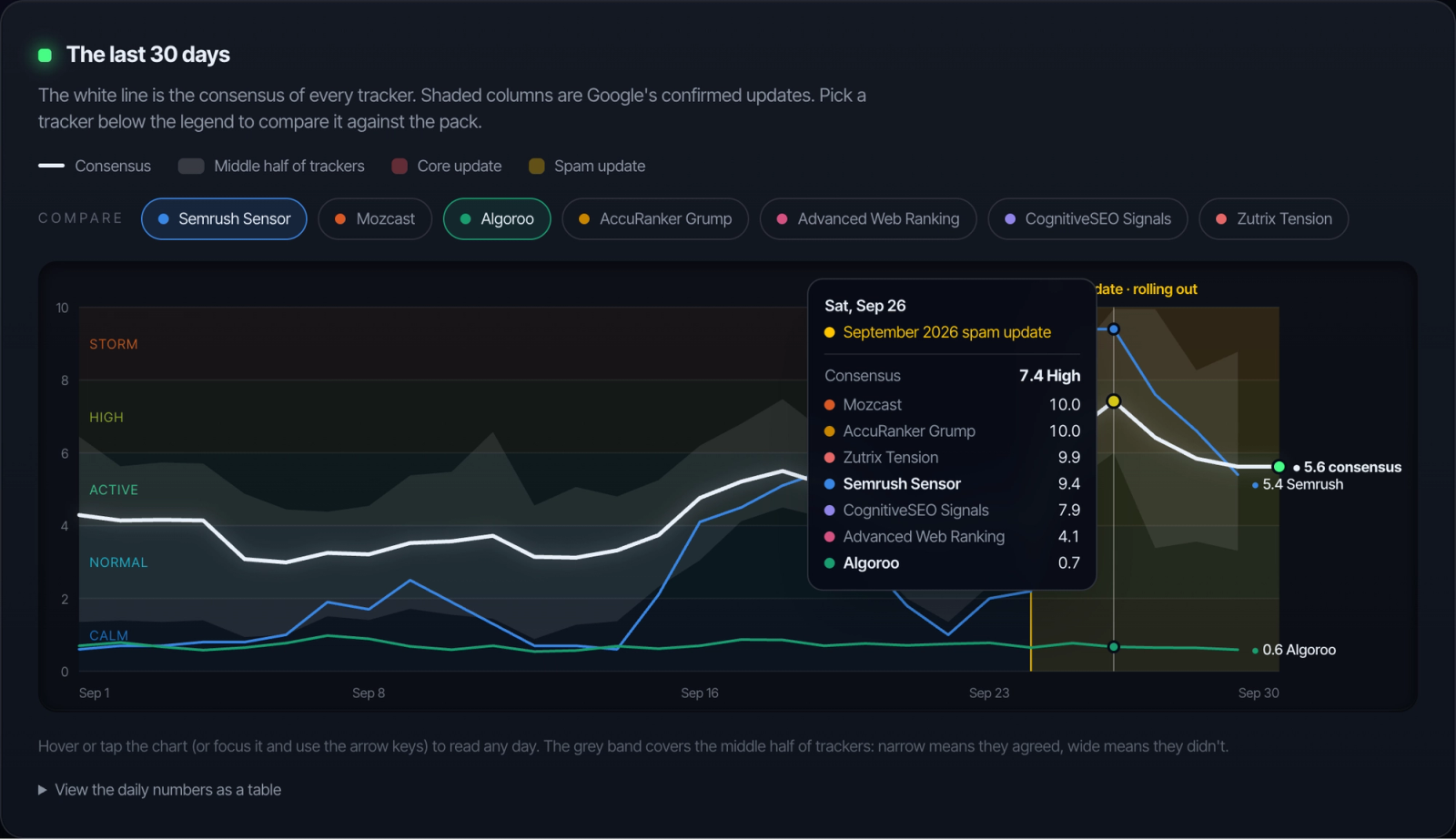
All values below are each tracker's reading converted to the same 0–10 scale, where 0–2 is calm and 8–10 is a storm.
- Tue Sep 22 – Thu Sep 24 (before and on announcement day): consensus between 3.9 and 4.3. Normal. Semrush Sensor was sitting at 1.0–2.2.
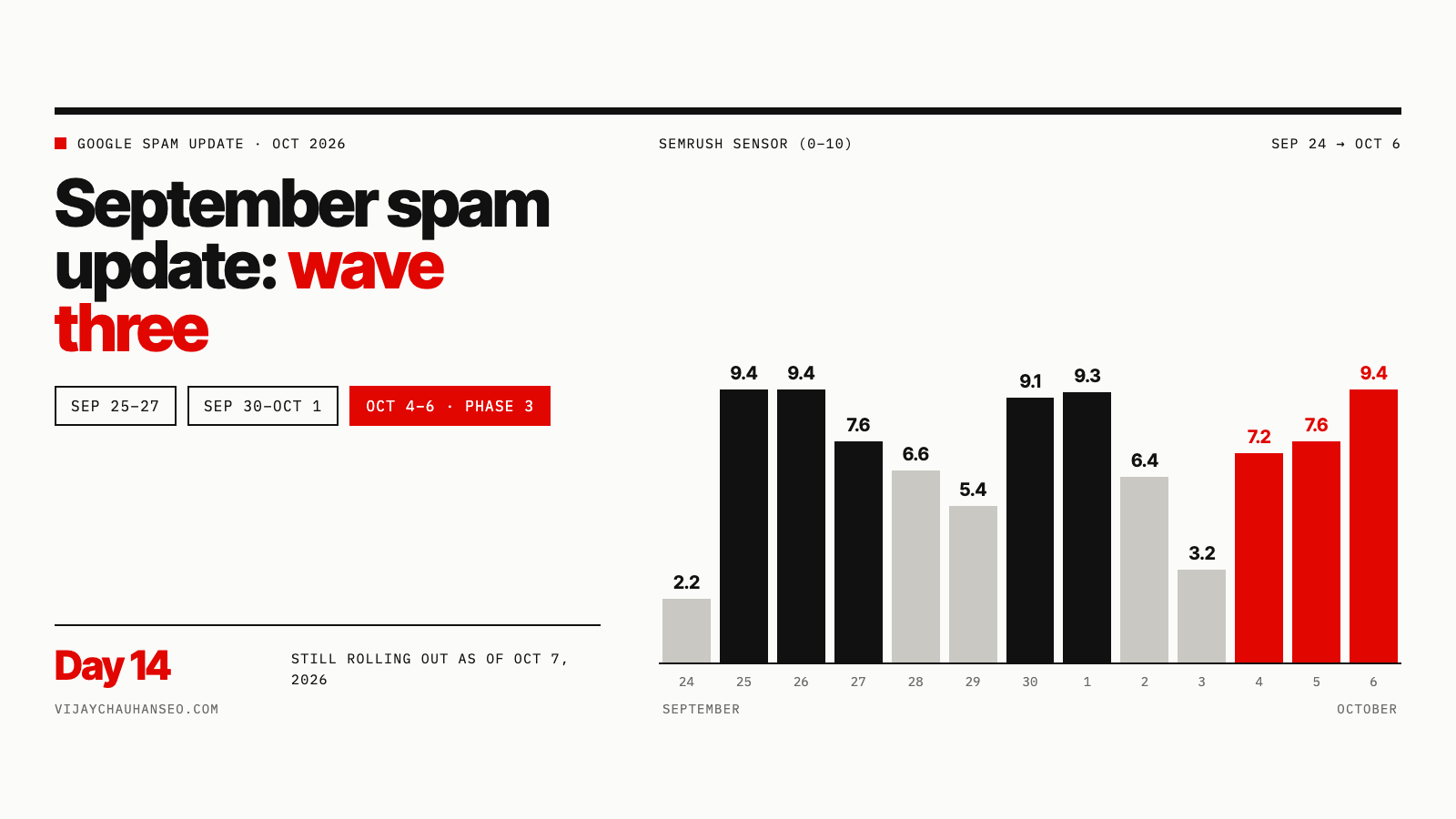
- Fri Sep 25: consensus jumps to 6.5. Semrush goes from 2.2 to 9.4, Mozcast from 3.2 to 7.6, Zutrix from 6.5 to 9.9 and CognitiveSEO from 5.1 to 7.8.
- Sat Sep 26: the peak at 7.4. Mozcast and AccuRanker both max out at 10, Zutrix sits at 9.9 and Semrush at 9.4.
- Sun Sep 27: easing to 6.4. CognitiveSEO drops back to 3.4 and Semrush to 7.6, while Mozcast and AccuRanker stay at 10.
- Mon Sep 28 – Tue Sep 29: 5.8, then 5.6. Still "Active", and Mozcast reported a 175°F temperature on the 29th, far above the top of its usual range.
Five trackers agreed. Two barely moved.
On Saturday, five of the seven trackers were at 7.9 or higher. That kind of agreement is the strongest sign you get that something broad happened, rather than one tool's keyword set having a bad day.
The other two tell a different story. Algoroo stayed between 0.6 and 0.8 for the whole period, and Advanced Web Ranking between 3.1 and 4.3. That doesn't mean they are wrong. Every tracker watches its own keywords, countries and devices, and a spam update hits specific sites rather than shuffling everything. If a tracker's keyword set doesn't include many of the affected sites, it will stay calm while others spike.
This is exactly why I built the tracker to show agreement and not just an average: a single number would have hidden the split.
What SEOs are reporting
Early reports line up with the timing. Search Engine Roundtable covered the weekend movement, including examples shared by Glenn Gabe of drops on AI-generated and programmatic content sites, across several verticals and countries. That fits the pattern of a spam update: concentrated hits on certain kinds of sites rather than an even reshuffle.
Where things stand now
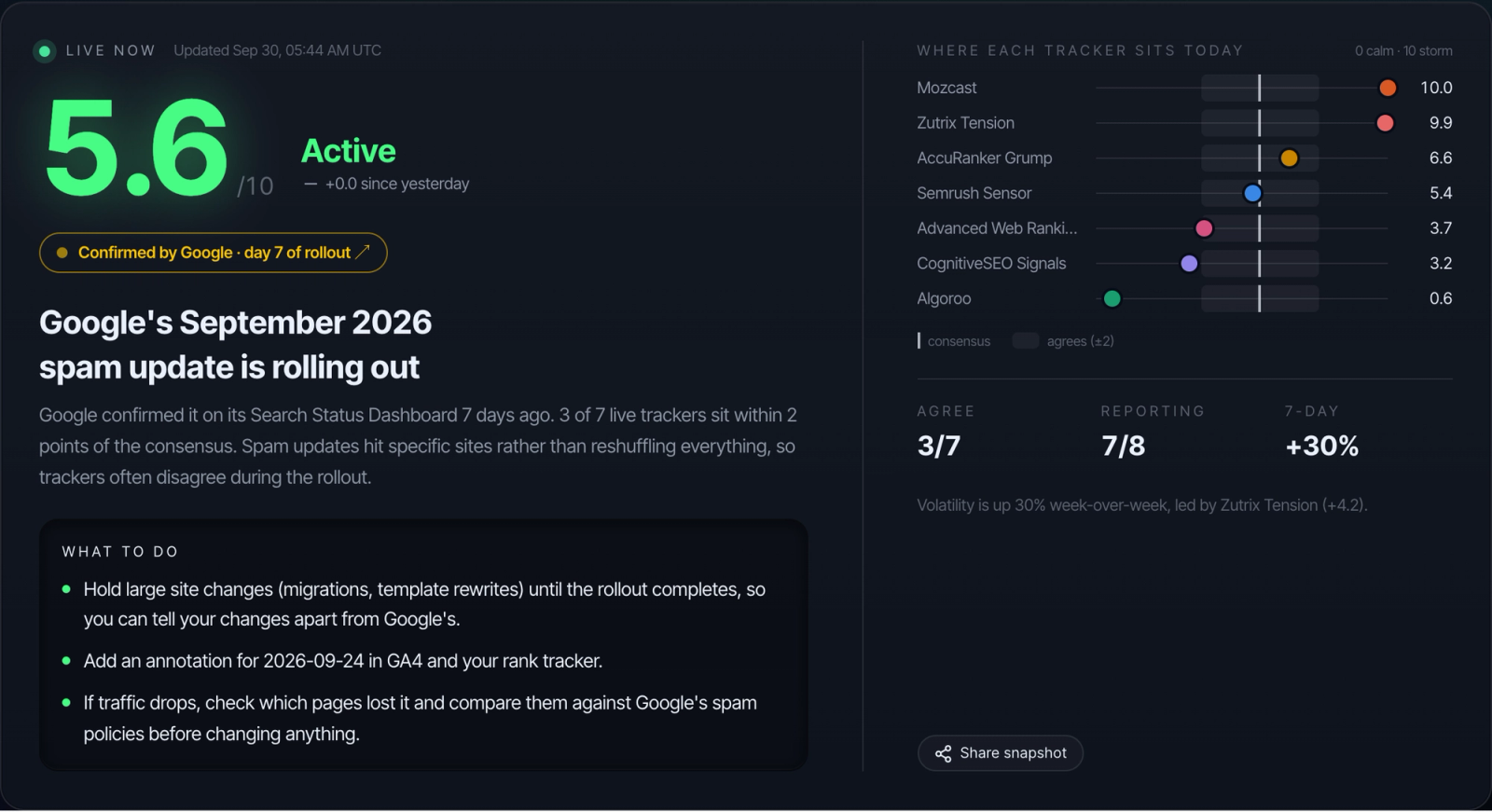
As of September 30 the rollout is on day 7 and Google hasn't marked it complete. The consensus has settled in the mid-5s, but a few trackers are still at the top of their scales, so it is too early to call it over. The live tracker picks up Google's status automatically: the banner will change the moment Google marks the update complete.
What to do while the rollout continues
- Don't make big site changes until it's finished. Migrations, template rewrites and mass content edits make it impossible to tell your changes apart from Google's.
- Annotate September 24 in GA4, Search Console reports and your rank tracker, so you can compare before and after cleanly.
- If traffic dropped, find out where. Break it down by page type and template. Spam updates rarely hit a whole site evenly, and the pattern usually tells you which policy is involved.
- Check the affected pages against Google's [spam policies](https://developers.google.com/search/docs/essentials/spam-policies), especially scaled content abuse, site reputation abuse and expired domain abuse, before you rewrite anything.
- Wait for the rollout to complete before judging recovery work. Rankings can keep moving for days after Google marks it done.
If you were hit and want a second opinion on what happened, that is the kind of work I do in a technical SEO audit.
How this data works
The Google volatility tracker pulls daily readings from seven public trackers: Semrush Sensor, Mozcast, Algoroo, AccuRanker Grump, Advanced Web Ranking, CognitiveSEO Signals and Zutrix Tension. Each one uses its own unit (Mozcast reports a temperature, Algoroo a "roo" score), so every reading is mapped onto one 0–10 scale. The consensus is their average; when a tracker hasn't published yet for a day, its most recent reading from the last three days is used, so one early publisher can't swing the number. Dates are each tracker's own reporting day. Update dates come straight from Google's Search Status Dashboard.
It's free, needs no signup, and refreshes every few hours. Bookmark it for the rest of this rollout and the next core update.
See today's Google volatility across seven public trackers on one 0–10 scale, checked against Google's confirmed updates. Free, no signup.
Open the volatility tracker