Google Opens Applications for Its UGC Fresh Data Program

Contents
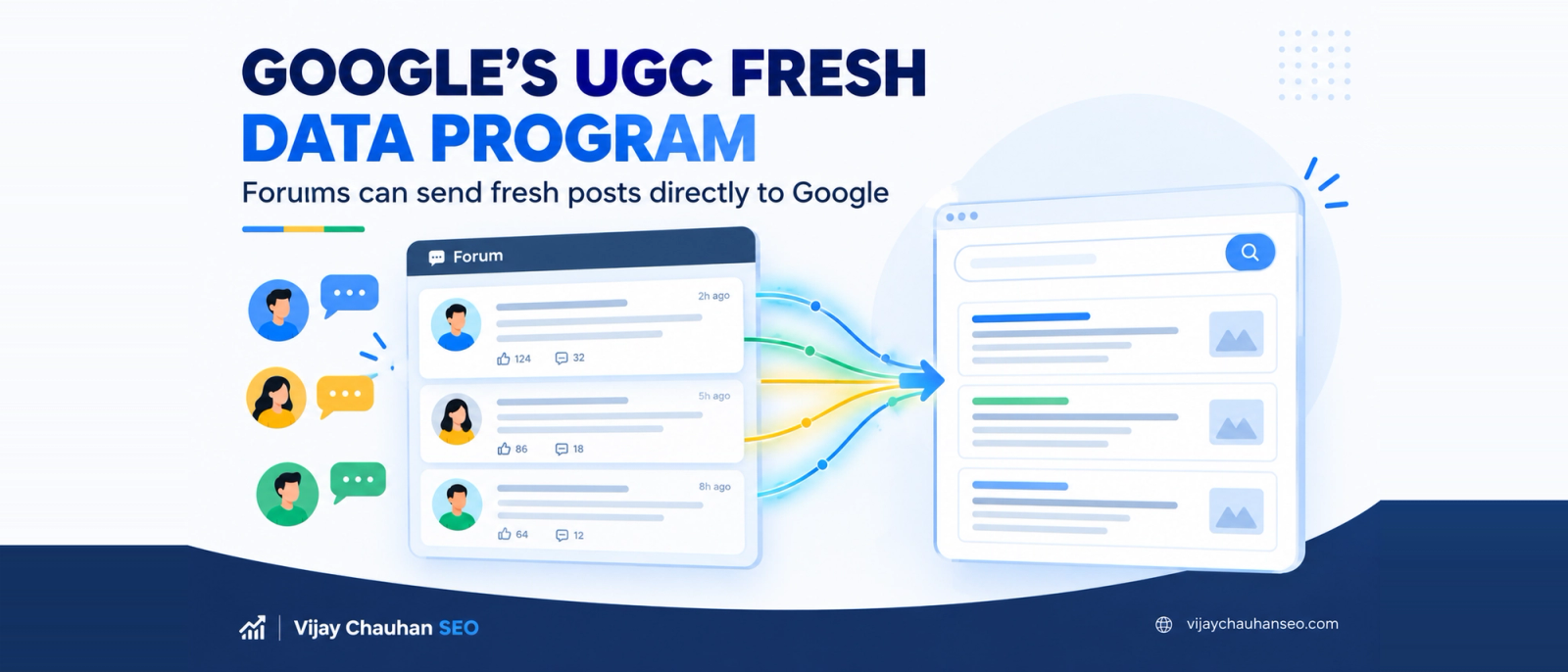
Google has opened applications for a new way to get forum and social posts to Google: instead of waiting for Googlebot to find them, platforms that Google approves can send new posts and their engagement numbers directly to Google. It's called the UGC Fresh Data Program, and Google documented it on October 8, 2026, in a new Search Central page and an entry in its documentation changelog.
It isn't open to everyone. You have to apply, Google reviews each platform, and the technical bar is high. But it's the first time Google has described a push route for user-generated content (UGC) that any qualifying platform can apply for, and the eligibility rules say a lot about what Google wants from forum content.
What Google launched
In Google's words, the program is "an initiative designed to help platforms display fresh, high quality, and authentic user-generated content (UGC) across various features on Search." Approved platforms get "a dedicated data ingestion pipeline to send content and interaction signals to Google."
Three details matter most:
- It's push, not crawl. The platform sends the post to Google as soon as it's created. Google says it's "independent of the Google Indexing API and traditional organic crawling."
- It carries engagement, not just content. Platforms must also send updated interaction counts, such as likes and replies, during the first 72 hours after a post goes up.
- It doesn't guarantee anything. Google states plainly: "This program doesn't guarantee that content will appear in Search."
Google didn't post a separate announcement on its blog or social accounts. The documentation page and the changelog entry are the only official sources so far.
Who qualifies
Google lists six requirements. Here they are, with what each one means in practice:
| Requirement | What Google asks for | What it means in practice |
|---|---|---|
| Content focus | Platform primarily hosts UGC, social posts or forum discussions on dedicated pages with stable URLs | Every post or thread needs its own permanent URL. Profile pages and feeds don't count. |
| Volume and audience | High volume of UGC and a significant user base | No numbers are given. Small niche forums are unlikely to get in. |
| Accessibility | Public pages Googlebot and users can see; no login or paywall; every post tied to a creator with a public profile | Members-only boards are out. Anonymous posting without a public profile doesn't fit. |
| Technical readiness | OAuth 2.0 API authentication, strictly validated JSON-LD payloads, valid schema.org markup on the pages | You need engineers who can build and maintain an authenticated API integration. |
| Moderation | No illegal content, active moderation and a way for users to report posts | Your moderation process has to exist and work, not just be written down. |
| Freshness | Posts sent ideally within minutes; engagement counts updated within 72 hours of creation | Sending from a nightly batch job won't qualify. Each post has to go out when it's created. |
How it differs from crawling and the Indexing API
Most site owners know two ways into Google's index: wait for Googlebot, or ping the Indexing API. This is a third route, and it's narrower than both.
| Organic crawling | Indexing API | UGC Fresh Data Program | |
|---|---|---|---|
| Who can use it | Any site | Any site, but only for job postings and livestream videos | Approved UGC platforms only |
| What gets sent | Nothing; Google fetches the page | A notification that a URL changed | The content plus engagement signals |
| Speed | Depends on crawl priority | Faster recrawl of that URL | Sent within minutes of posting |
| Access | Automatic | Self-serve via Google Cloud | Application form, reply in 6–8 weeks |
That Indexing API restriction is real. Google's Indexing API docs say it "can only be used to crawl pages with either JobPosting or BroadcastEvent embedded in a VideoObject." Plenty of forums have tried it for regular threads anyway. This program is Google offering a supported route for that content instead.
Why Google wants this
Google has been putting more forum and social content in its results for a couple of years, through features like Discussions and forums and Perspectives. The problem with that kind of content is speed. A thread about a product launch, an outage or a breaking story is most useful in its first few hours, and crawling doesn't always pick it up that fast.
Google already has a fast route for one platform. When it expanded its partnership with Reddit in February 2024, the deal included access to Reddit's Data API. The UGC Fresh Data Program looks like a way to give other platforms a similar route, with a standard application instead of a one-off deal. That's my reading, not something Google has said.
The engagement requirement fits a pattern too. On September 24, two weeks earlier, Google updated its video structured data docs to add the creator property and document which interactionStatistic types it supports. Creator attribution and interaction counts keep coming up in what Google documents, and this program requires both.
What forum and community owners should do now
Even if your platform is too small for the program today, the requirements are a good checklist for how Google wants UGC presented. Most of them help with normal crawling too.
- Give every thread a permanent URL. If posts only live inside feeds, infinite scroll or JavaScript-only views, fix that first. My SSR Inspector Chrome extension compares the raw HTML a crawler receives with the rendered page, so you can see if a thread's text is only there after JavaScript runs.
- Add DiscussionForumPosting or SocialMediaPosting markup. Google's discussion forum structured data guide covers the fields, including author, datePublished, the post text, comments and interactionStatistic (likes, replies, shares).
- Make creators public. Each post should link to a public author profile. Google supports ProfilePage markup for those pages.
- Show your moderation. Visible report buttons, community rules and removal of illegal content are now listed requirements, not just good practice.
- If you're large enough, apply. The application form is linked from Google's page. Expect a reply in 6–8 weeks. Google sends the developer documentation only after it accepts you.
What we still don't know
- The volume threshold. Google says "high volume" and "significant user base" without numbers.
- Where the content appears. Google says "various features on Search" but doesn't name them. Discussions and forums, Perspectives and AI Overviews are the obvious candidates, but that's a guess.
- Whether it affects ranking. Being processed faster isn't the same as ranking higher, and Google makes no promise about either.
- Who is already in. Google hasn't named any participating platforms.
Sources
My SSR Inspector Chrome extension compares the raw HTML crawlers receive with the rendered page, so you can spot thread content that only exists after JavaScript.
See the SSR Inspector