Google Manual Actions: What Marie Haynes and Glenn Gabe Are Seeing Right Now

Contents
This week, a post from Marie Haynes stopped me while scrolling X.
She said she is getting a lot more requests for help with Google manual actions.
Not algorithm drops. Manual actions. The ones where someone at Google reviews your site and you get a notice in Search Console.
I have been following the September 2026 spam update closely for the last two weeks, so this caught my attention. I went back through what Marie shared, and through what Glenn Gabe has been posting and writing, because both of them spend their days looking at sites that got hit.
Here is what they are seeing, what Google has said recently, and what I would check on your own site.
Important note
Google has not confirmed any increase in manual actions.
What I am sharing below comes from public posts by Marie Haynes and Glenn Gabe, plus a recap of a Google event. I am not saying every site is at risk, and I am not judging any site that has received a manual action. This is about understanding the signals and staying prepared.
What Marie Haynes shared
Marie has worked on manual action recoveries for more than a decade. On October 6, she posted this:
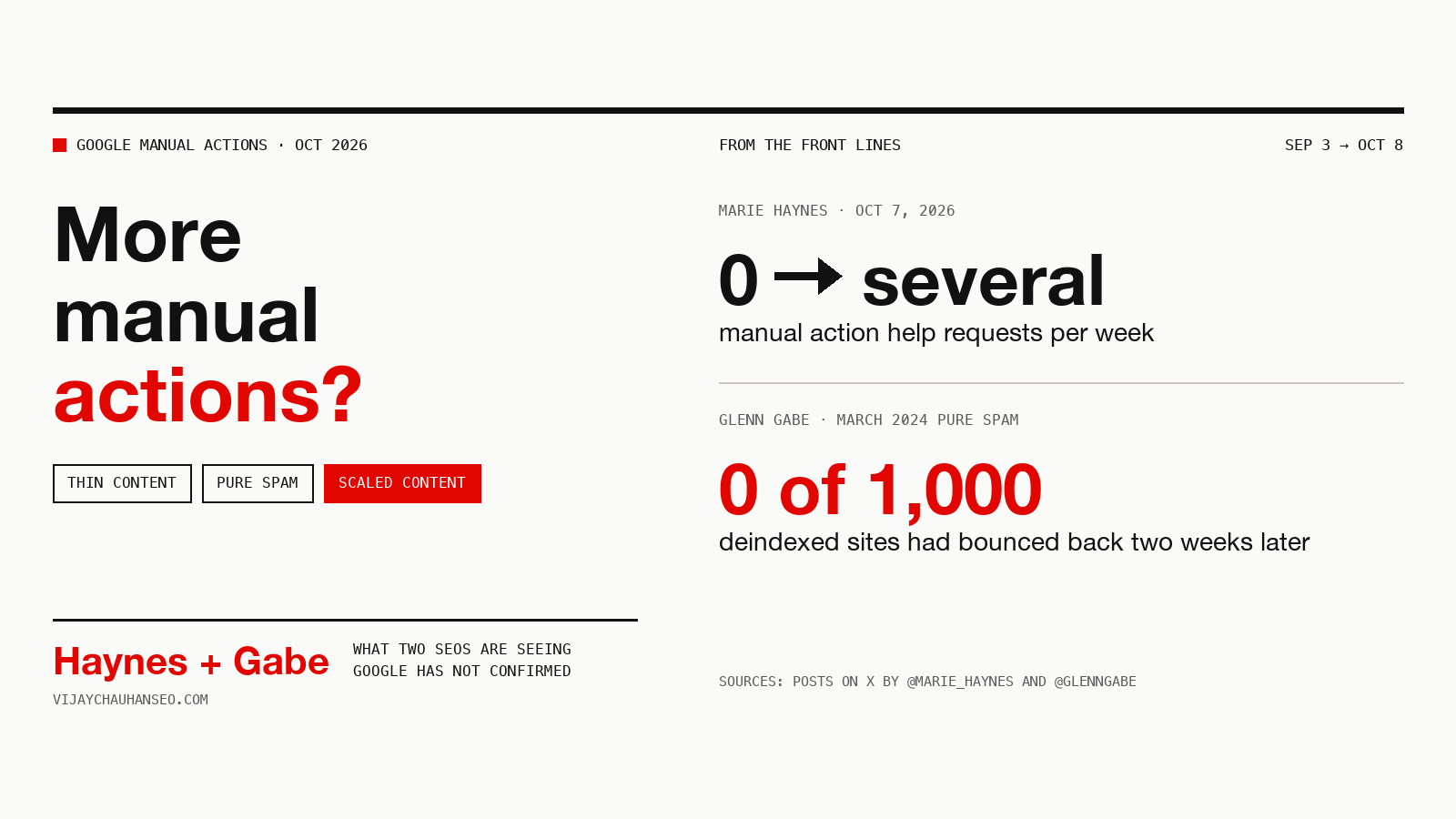
Have had a big increase in requests for help with manual actions lately. These include thin content, pure spam, and scaled content. Most of these sites are legitimate long standing businesses.
— Marie Haynes (@Marie_Haynes) October 6, 2026
The next day, she added some context:
Went from essentially no requests to several per week. It's not nearly as high as the pre-Penguin manual action era, but interesting considering I don't actively talk about or advertise consulting around manual actions anymore.
— Marie Haynes (@Marie_Haynes) October 7, 2026
Two things stood out to me.
First, these are mostly legitimate, long-standing businesses. Not throwaway sites.
Second, she is not even promoting manual action services anymore. People are finding her on their own.
She was also clear that the volume is still far below the 2012 era. So this is a noticeable change, not a flood.
Why Marie thinks this is happening
In the same thread, Marie compared it to late 2011 and early 2012. Back then, Google issued a lot of manual actions for unnatural links, and a few months later Penguin launched as an algorithm.
Her view is that Google uses waves of manual actions for two reasons:
- To find examples that can help train machine learning systems later.
- To learn from reconsideration requests, where site owners explain what they did and what they fixed.
She also said she still thinks a big update may be coming.
That is her opinion based on experience, not something Google has announced. But I think it is a useful way to look at it.
What Glenn Gabe has been documenting
Glenn has not posted that he is seeing more manual actions. What he has done, many times, is show what happens to a site after one.
I think that matters just as much.
1,000 sites, no quick recovery
In March 2024, Google issued a wave of pure spam manual actions. Glenn tracked 1,000 of the affected sites:
Quick Manual Actions Update: I ran the visibility numbers for 1,000 sites deindexed by pure spam manual actions and the drops are insane. I didn't see one bounce back, get reindexed, etc. out of the 1K list.
— Glenn Gabe (@glenngabe) March 20, 2024
Not one of the 1,000 had come back two weeks later.
The impact can reach AI search too
In April 2026, Glenn published a case study on a site that had a large section of AI-generated local news pages. After a scaled content abuse manual action, that section was removed from Google's index.
He then checked ChatGPT. The section had almost disappeared from ChatGPT citations as well.
This is the part I keep thinking about. A manual action is no longer only a Google problem. Glenn's point was that the drop can carry into AI Overviews, AI Mode and then other AI search tools.
Glenn's long-term view
Glenn has said for a long time that manual actions alone are not the long-term answer. He wrote about this in 2024 when discussing site reputation abuse:
Here's another example of a manual action for 'Site reputation abuse' being removed. I've seen several removed over the past two weeks. But like I've said for a while, manual actions are not the solution IMO. An algorithmic approach is the path forward.
— Glenn Gabe (@glenngabe) December 22, 2024
If you read this next to Marie's thread, they come from different angles but point in a similar direction. Manual actions are hard to scale. Algorithms are where Google usually ends up.
What Google said at Search Central Live
A few days before Marie's post, Glenn shared notes from John Campbell's recap of Google Search Central Live Deep Dive in Barcelona:
Google on more spam updates: "There have been more spam updates recently because there is so much more new content. The team is now using AI to help catch more of it."
— Glenn Gabe (@glenngabe) October 4, 2026
I read the full recap. A few lines from Googlers are worth knowing:
- Duy Nguyen, Search Quality Analyst: "A high percentage of content is spam, and that is what the spam updates target."
- Gary Illyes: "scaled content is now becoming more of a problem than link spam."
- Eric Murillo, Trust and Safety Analyst for Discover: "If a manual action is taken against your site, it will appear in Search Console."
This does not confirm more manual actions. But it does tell us where Google's attention is right now: scaled content, and using AI to find it.
Quick timeline
| Date | What happened | Source |
|---|---|---|
| Sep 12 | Glenn Gabe and Marie Haynes both report sharp drops from an unconfirmed change around Sep 3–4 | Posts on X |
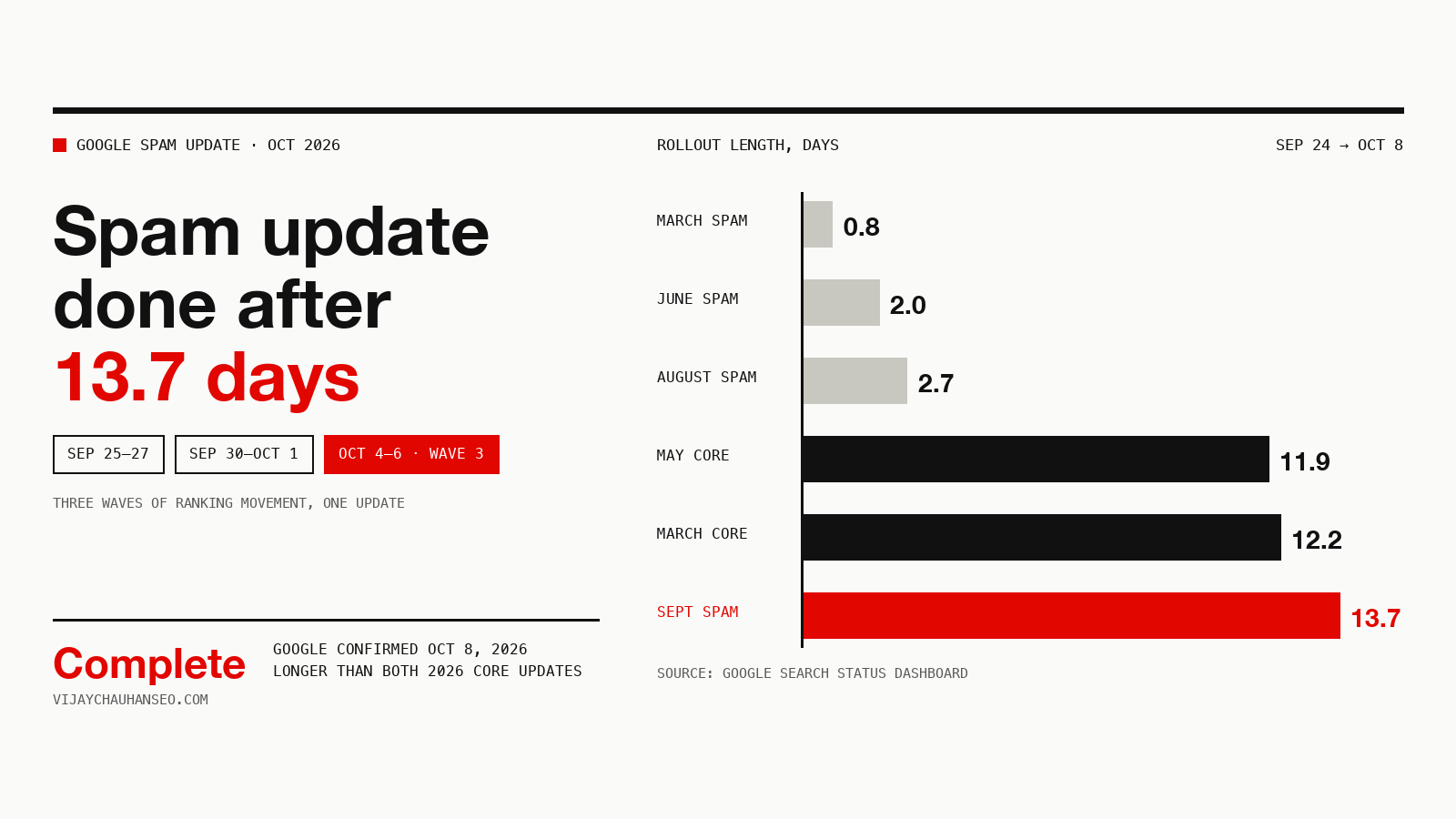
| Sep 24 | September 2026 spam update starts | Google Search Status Dashboard |
| Oct 2 | Googlers talk about more spam updates and AI-assisted detection in Barcelona | ROAST recap |
| Oct 4 | Glenn Gabe shares the spam notes from the event | Glenn Gabe on X |
| Oct 6–7 | Marie Haynes reports more manual action requests | Marie Haynes on X |
| Oct 8 | September 2026 spam update completes | Google Search Status Dashboard |
Daniel Foley Carter posted on October 7 that he has also been seeing more manual actions over the last few months. Barry Schwartz looked at the Google Search Central Help Community and found a group of recent manual action threads, mostly for major spam problems, thin content, pure spam and scaled content abuse. He described the increase as small compared with a decade ago.
How to check your own site
If your traffic dropped recently, this is the order I would follow.
- Open Search Console and check Security & Manual Actions, then Manual actions. If it says "No issues detected", it is not a manual action. It is more likely an algorithm update.
- If there is an action, read it carefully. The manual actions report tells you if it affects the whole site or only some pages, and which policy it relates to.
- Read the matching section of Google's [spam policies](https://developers.google.com/search/docs/essentials/spam-policies). Then fix the issue across the whole site, not only the sample URLs Google shows.
- Be honest in your reconsideration request. Explain what happened, what you changed and how you will prevent it. Marie has made this point many times.
- Be patient. At the same event, Gary Illyes said manual action removal typically takes 1–2 weeks, 4–6 weeks at the slowest, and longer for dormant sites. Removal also does not mean all rankings return right away.
My takeaway
I don't see this as a reason to panic.
It is a few experienced people sharing what they see, and Google has not confirmed anything.
But when Marie, Glenn and Google's own speakers are all talking about scaled content in the same few weeks, I pay attention.
If you have published a lot of pages quickly, with little review, now is a good time to go back and check them. Ask a simple question: would this page still be useful if search engines did not exist?
I will keep watching how things move on my Google Search Volatility Aggregator.
Have you seen more manual actions in Search Console recently? I would like to hear what types you are seeing.
Sources
My free Google Search Volatility Aggregator combines the major public trackers into one 0–10 reading, flags confirmed updates, and shows how many trackers agree.
Check today’s volatility