Contents
- Important Note
- Quick Discovery Table
- The First Breakthrough: AI Overview Interaction
- SERP heartbeats, page lifecycle & feature activity
- The Smoking Gun: Back Button Telemetry
- Clicks Are Wrapped in Context
- New Finding: Attention rollups: hovers before clicks
- Feature IDs Are Expanding
- AI Mode Has Its Own Pipeline
- SERP Features Have Their Own Context
- Performance Is Also Logged
- One More Strange Signal: Header Interaction
- What This May Mean for SEO
- What I Can Say Confidently
- What I Am Not Claiming
- Final Thought
- Open Collaboration
A few days ago, Przemysław Charchan commented on one of my posts and shared his article: The Multidimensional Role of Clicks in Evaluation and Ranking.
I opened it casually.
Bad decision.
A few minutes later, I was back in Chrome DevTools, watching Google Search send background requests to one tiny endpoint again and again:
/gen_204
Przemysław’s article made a simple but important point: Google does not seem to treat a click as a single isolated event. A click has context. What was visible? What did the user interact with? Did they return? Was it a quick click, a long click, or part of a messy search journey?
That pulled me back into reverse-engineering.
So I built a Chrome extension called AIO/AIM Inspector to capture Google SERP telemetry directly from the browser.
I tested organic results, AI Overviews, AI Mode, follow-up modules, SERP features, back-button behavior, hover/attention signals, and performance telemetry.
Across multiple captures, I collected hundreds of events from:
/gen_204/client_204/log
And the more I captured, the more it looked like this:
Google is not just counting clicks.
Google may be measuring the whole search journey.
Important Note
This article is based on my own reverse engineering, browser telemetry captures, and analysis from my Chrome extension.
I am not claiming these parameters are confirmed ranking factors.
I am not claiming Google uses this data in any specific ranking system.
I am not trying to influence or misrepresent anything.
I may be wrong in some interpretations.
What I am sharing is what I captured, how I interpreted it, and why I think it deserves more investigation from the SEO and search-quality community.
Quick Discovery Table
The First Breakthrough: AI Overview Interaction
The first big signal came from this query:
best things to do near me
When I interacted with the AI Overview area, Google fired:
t=fi
et=pointerdown
st=6434
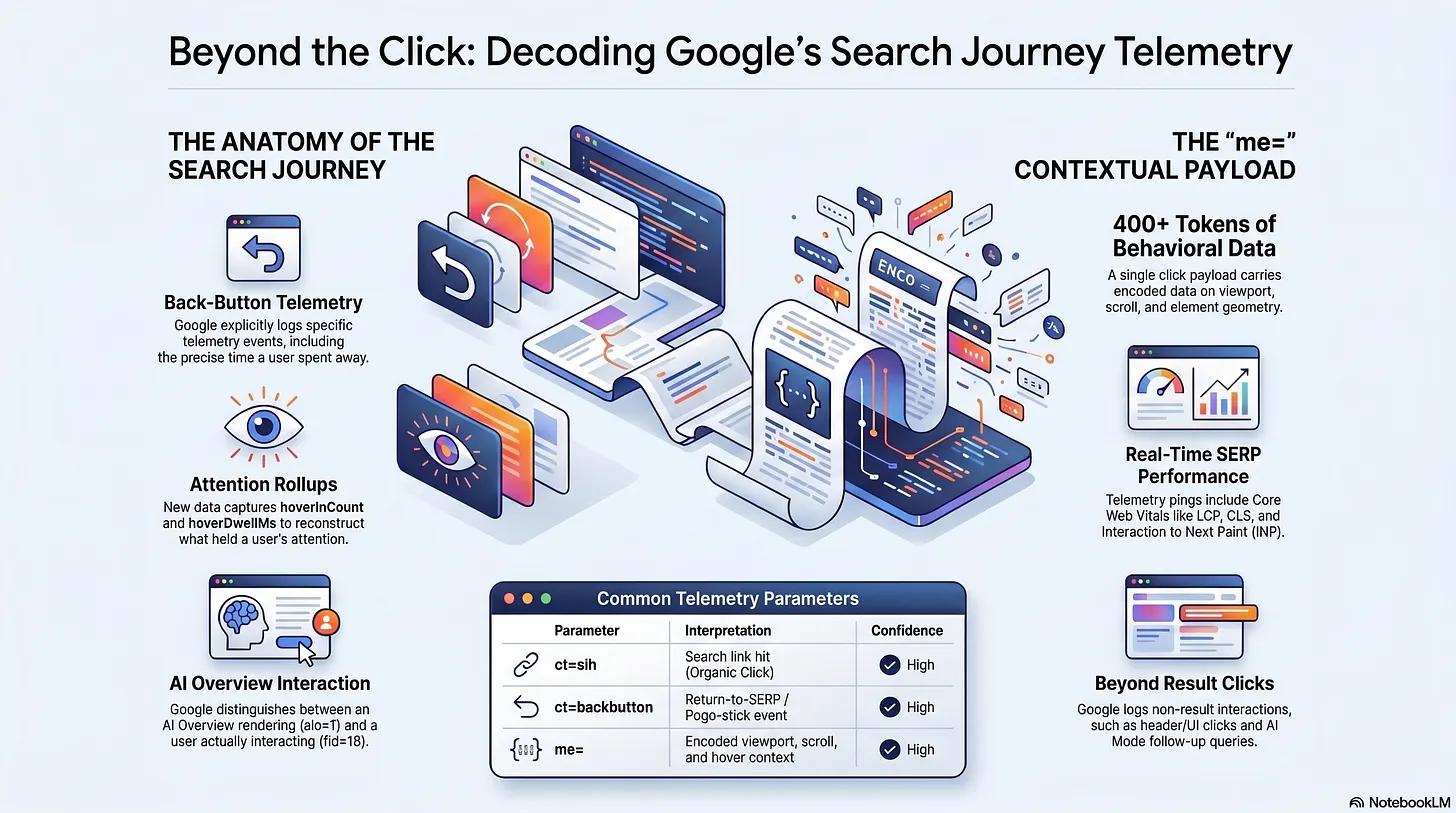
fid=18
My interpretation:
t=fi feature / first interaction
et=pointerdown user clicked or pressed
st=6434 around 6.4 seconds before interaction
fid=18 feature ID
This was not simply “an AI Overview existed.”
This was Google logging that a user interacted with a specific SERP feature after measurable attention time.
Later, I found another AIO signal:
aio=1
That appeared when an AI Overview was rendered.
So the model became:
aio=1 AI Overview was presentfid=18 user interacted with the AI Overview
That distinction matters.
Most SEO tools ask: “Was there an AI Overview?”
Google’s telemetry may be able to ask: “Did the user actually engage with it?”
SERP heartbeats, page lifecycle & feature activity
Beyond clicks, the telemetry contains heartbeat and lifecycle events. I observed /gen_204 calls with:
ct=srpf- a heartbeat or “SERP foreground” ping that fires periodically to let Google know the page is still in focus.ct=psnt- a page‑seen event marking when the SERP enters and leaves the viewport (useful for timing exposure).ct=fa- signalling that a particular search feature (e.g., a carousel or knowledge panel) is active in the viewport.ct=ejsawithtype=mousedownandl=header— logging interactions with the header or other non‑result UI elements.
These events suggest that Google is building a complete timeline of the session, not just the endpoints. They know when a result comes into view, when a feature becomes interactive and when the user interacts with the UI chrome.
The Smoking Gun: Back Button Telemetry
Another major moment came from:
things to do in bali
This session had many organic clicks, AIO presence, SERP heartbeats, and then this:
ct=backbuttontt=popstatetrs=476884nt=navigate
Decoded carefully:
ct=backbutton user returned with the back buttontt=popstate browser history eventtrs=476884 time away from SERP, around 7.9 minutesnt=navigate navigation event
This is not me guessing that pogo-sticking happened. The browser explicitly sent Google a back-button return event.
In another capture, I found:
ct=backbuttontt=popstatetrs=215290
That is roughly 3.6 minutes away from the SERP before returning.
Again, I am not claiming direct ranking use. But Google appears to have the telemetry needed to measure return-to-SERP behavior.
Clicks Are Wrapped in Context
Organic clicks appeared as:
ct=slhLikely “search link hit.”
But the real payload was inside:
me=
Some me payloads were short. Others had more than 400 tokens. One capture had 475 tokens in a single click payload.
Inside those payloads I repeatedly saw codes like:
R geometry / region dataG gesture or pointer movementS scrollV viewporth hover or attention-like transitioni in-view transitiono out-of-view transition
In simple English:
The click is not just a click.
The payload carries the scene around the click: what was visible, where elements were, whether the user scrolled, how the viewport looked, and what interaction mode was used.
A click becomes a compressed behavioral record.
New Finding: Attention rollups: hovers before clicks
The most intriguing discovery was a new attentionRollup object summarising hover behaviour. For each query, it grouped hover counts and dwell times by vet codes (visual element identifiers). For example:
- Query: latest seo news for ranking —
vet=CAwQAgrecorded 5 hover‑ins and ~11.2 seconds of dwell. - Query: latest AEO tips —
vet=CE0QAA,CEwQAAandCEsQAAeach captured ~1.3 s of hover on different elements. - Query: what is difference between SEO & GEO ? — several VETs accumulated between 0.3 s and 1.2 s of dwell, indicating sustained attention on specific results.
The latest capture added a major new object:
attentionRollupThis grouped hover and dwell-like behavior by visual element IDs.
Example:
query: latest seo news for rankingvet: CAwQAghoverInCount: 5hoverDwellMs: 11231
These rollups show that Google is tracking pre‑click attention. Instead of only recording what gets clicked, they can see which elements a user hovered over and for how long. This could provide a proxy for interest or curiosity, and it supports the idea that user satisfaction involves more than clicking – it also includes examining and engaging with the content.
This is one of the most interesting findings so far.
It suggests the telemetry contains enough information to reconstruct not only what was clicked, but what likely held attention before the click.
That maps closely to Przemysław’s broader idea: clicks > attention > satisfaction.
Feature IDs Are Expanding
Across captures, I found multiple feature IDs:
fid=9fid=13fid=14fid=15fid=18fid=268
Examples:
fid=18 AI Overview interaction candidatefid=15 recurring SERP feature interactionfid=13 recurring non-AIO SERP feature interactionfid=9 newly observed feature interactionfid=14 newly observed feature interactionfid=268 appeared on AIM / AI Mode surface
The most interesting one is:
s=aimt=fiet=pointerdownst=6865fid=268
This appeared on the AI Mode surface.
That suggests AI Mode may have its own feature interaction IDs, separate from classic SERP features.
AI Mode Has Its Own Pipeline
AI Mode did not behave like normal organic search.
I captured events like:
astyp=aim_folwr
folid=aim-chrome-initial-inline-async-container
And follow-up events like:
astyp=folsrchfolid=B2Jtydaimq=22269
aimq is especially interesting. It looks like an AI Mode query or follow-up identifier, but I am not fully sure yet.
This suggests AI Mode is not just “search with a chat box.”
It seems to have its own telemetry layer for rendering, restoring, follow-ups, and interaction loops.
That makes sense. AI Mode behavior is different from classic search behavior.
A user may not click a blue link. They may ask another question, expand a module, inspect a citation, or leave without clicking anything.
Google needs different instrumentation for that kind of experience.
The telemetry suggests that instrumentation already exists.
SERP Features Have Their Own Context
I also saw SERP feature telemetry involving:
vedvetuactlplvwd
These appear to encode visual/contextual information about SERP elements and interactions.
One interesting pair:
uact=1vwd=CioIhr_Sr9wzEKTF0q...
Then another:
uact=1vwd=Eg4QAhoKEAUYhpo...
I am treating vwd carefully. It looks like an opaque encoded payload, possibly protobuf-like. I do not want to claim more than the data supports.
But it appears with feature-action telemetry, which makes it worth tracking.
Performance Is Also Logged
The latest capture showed page-health telemetry:
t=phinp=368vlss=...
inp=368 looks like Interaction to Next Paint, a Core Web Vital.
Earlier captures also showed:
fcplcpclsdclaft
Careful interpretation:
Google logs SERP performance and interaction performance back to itself.
I would not claim this proves these pings directly affect rankings, but the SERP is clearly instrumented for performance measurement.
One More Strange Signal: Header Interaction
I also captured:
ct=ejsatype=mousedownl=header
This was not an organic result click. It looks like a UI/header interaction.
So Google is not only logging result clicks. It also appears to log interactions with parts of the search interface itself.
What This May Mean for SEO
The old SEO model was:
rank higher → get more clicks
The better model may look like:
SERP feature appearsuser notices or ignores ituser clicks, scrolls, hovers, expands, asks, or returnsGoogle records the journey
For AI search, success is even more complex.
A user may read the AI Overview and stop.
They may click a citation.
They may ask a follow-up.
They may ignore the AI answer and click an organic result.
They may return to the SERP and keep searching.
Those are all different behaviors. Google’s telemetry appears capable of separating them.
What I Can Say Confidently
Based on my captures:
Google sends detailed SERP telemetry through /gen_204.Organic clicks are marked with ct=slh.Back-button returns can appear as ct=backbutton.AI Overview rendering can appear as aio=1.AI Overview interaction correlated with fid=18 in my captures.AI Mode has its own telemetry pattern.Feature interactions use fid, ved, vet, uact, and related fields.The me parameter contains rich visual and behavioral context.Attention-like behavior can be reconstructed from hover/dwell-style element data.SERP performance telemetry includes INP, FCP, LCP, CLS-like signals.
What I Am Not Claiming
I am not claiming /gen_204 is a direct ranking factor.
I am not claiming every parameter is permanently decoded.
I am not claiming fid=18 will always mean AI Overview across every Google experiment.
I am not claiming Google uses this exactly the way I interpret it.
This is reverse engineering. I might be wrong.
But I believe the data is interesting enough to share, test, and decode further.
Final Thought
Przemysław’s article gave me the spark.
AIO/AIM Inspector gave me the receipts.
And the telemetry showed something SEOs should take seriously:
Google Search is not just a results page.
It is also a measurement interface.
Every click, scroll, hover, AI Overview render, AI Mode follow-up, feature interaction, performance event, and back-button return may become part of the search journey Google observes.
So the real SEO lesson may not be only “get the click.”
It may be:
Earn attention.
Satisfy intent.
Reduce the need to return.
Understand AI surface behavior.
And study the full journey, not only the ranking position.
Open Collaboration
I am sharing this because I want more people to look at it.
If you are working on search quality, technical SEO, browser telemetry, AI Overviews, AI Mode, JavaScript instrumentation, or reverse engineering, I would love to collaborate.
DM me if you want to help decode this further. I am happy to share the raw JSON captures, code snippets, or the extension so other experts can validate, challenge, or expand these findings.
I am sure there are more discoveries inside this data.