How to think about AI search without losing SEO focus
February 12, 2026Read →
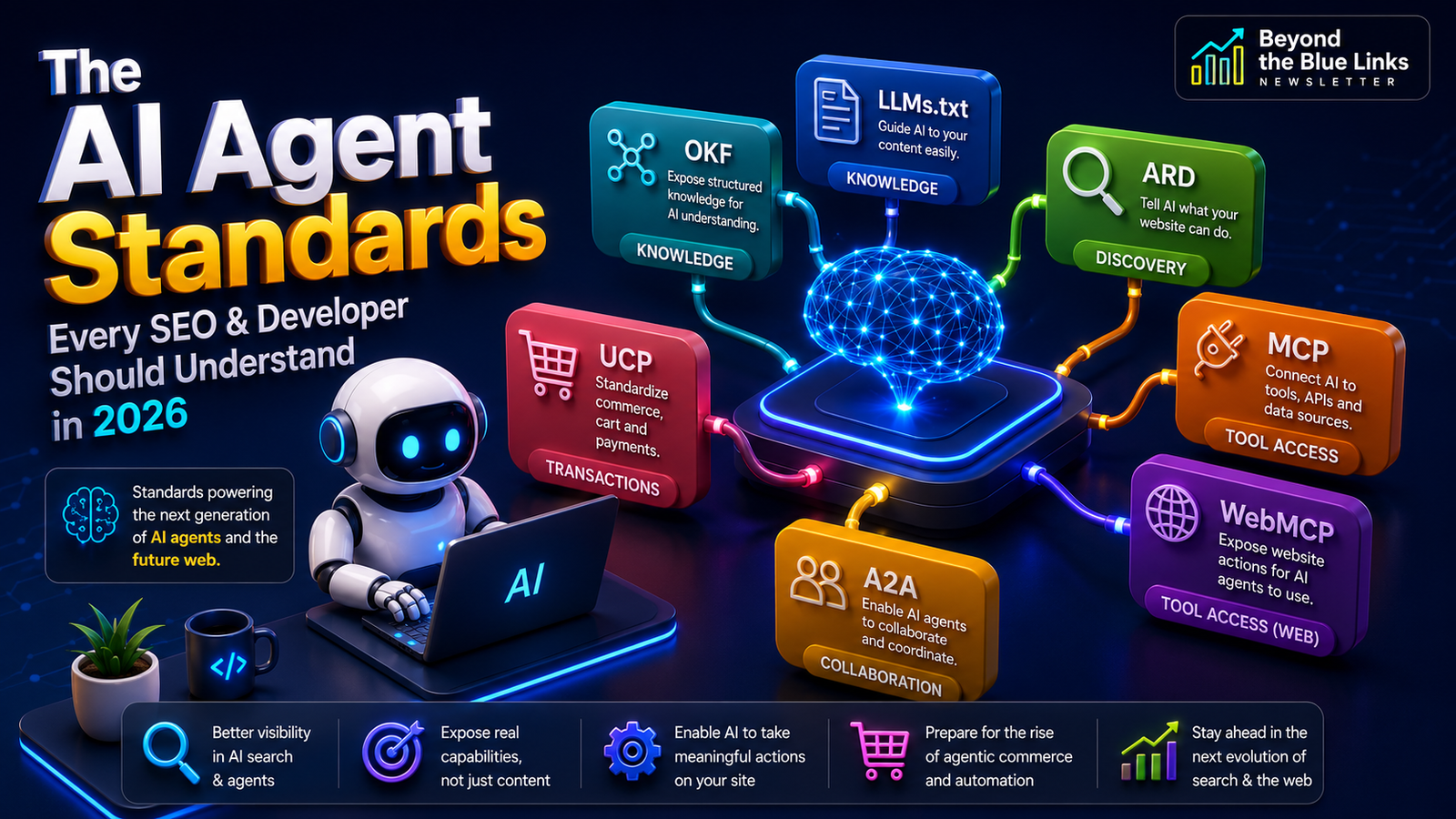
A practical guide to MCP, A2A, ARD, WebMCP, UCP, LLMs.txt, and why they matter for the future of AI search.
Every week a new AI protocol appears on LinkedIn.
One day it's MCP. The next day everyone is talking about WebMCP. Then Google introduces UCP, Anthropic expands MCP, and suddenly your feed is full of acronyms.
MCP. A2A. ARD. WebMCP. UCP. LLMs.txt.
At first glance, they all sound like competing technologies trying to become the next industry standard. But that's not actually what's happening.
Each of these standards solves a different problem in the rapidly evolving AI ecosystem. Some help AI agents discover websites, others enable them to perform actions, while a few allow multiple AI agents to collaborate or even complete purchases on behalf of users.
Understanding where each protocol fits is becoming increasingly important not just for AI developers, but also for SEOs, marketers, and businesses preparing for the next phase of search.
Let's break it down
The traditional web runs on common standards.
A browser requests a webpage, HTML defines its structure, CSS controls the design, and JavaScript adds interactivity. Because everyone follows these standards, browsers can understand and render websites consistently.
AI agents work differently.
Instead of simply reading pages, they need to:
Without shared protocols, every AI platform would have to integrate with every website differently. Standards solve this problem by creating a common language between AI systems and the web.
Rather than thinking of these protocols as competitors, it's more useful to see them as different layers of the same ecosystem
Each protocol focuses on a specific challenge.
One of the first standards to gain attention in the AI ecosystem wasLLMs.txt.
The idea is simple: instead of making AI models crawl hundreds (or thousands) of pages to understand your website, you provide a single Markdown file that summarizes your site's purpose, key sections, documentation, and important resources.
Think of it as an executive summary designed for AI systems and autonomous agents.
LLMs.txt has become one of the most debated AI standards of 2026.
Recently, theChrome team added an LLMs.txt audit to Lighthouseas part of its newAgentic Browsingcategory, encouraging developers to make websites more AI-agent friendly.
At the same time, theGoogle Search team has clearly stated that Google Search, AI Overviews, and AI Modedo not use LLMs.txt as a ranking or visibility signal.In its official guidance, Google says you don't need AI text files, Markdown files, or other machine-readable files to appear in Search or its generative AI experiences.
At first glance, these statements seem contradictory but they're addressing different problems.
In other words,LLMs.txt isn't an SEO ranking factor today, but it may improve how AI agents understand and interact with complex websites.
My recommendation is straightforward:
If your website includes extensive documentation, APIs, developer resources, or a large knowledge base, publishing anLLMs.txtfile is a low-effort enhancement that's worth considering.
However, don't expect it to improve your Google rankings or increase visibility in AI Overviews.
For now, high-quality content, structured data, and strong technical SEO remain far more important than adding an LLMs.txt file.
My take:LLMs.txt is still an emerging standard. Google Search may not use it today, but the fact that Chrome Lighthouse has started auditing it shows that the broader Google ecosystem is paying attention. It's a protocol worth watching not because it helps rankings today, but because it could become part of the future agentic web.
example >https://example.com/llms.txt
WhileLLMs.txtgives AI models a summary of your website,Open Knowledge Framework(OKF)goes much deeper.
Instead of simply telling AIwhat your website is about, OKF aims to expose the underlying knowledge that powers your website its entities, relationships, content structure, and metadata in a standardized, machine-readable format.
Think of it this way:
Rather than forcing AI systems to infer relationships between pages, products, people, locations, or services, OKF makes those connections explicit. This allows AI agents to understand not just individual pages, but how everything on your website fits together.
An OKFbundleis a directory of markdown files representingconcepts:anything you want to capture, including tables, datasets, metrics, playbooks, runbooks, and APIs. Each concept is one file. The file path is the concept's identity:
sales/
├──index.md
├── datasets/
│ ├──index.md
│ └── orders_db.md
├── tables/
│ ├──index.md
│ ├──orders.md
│ └──customers.md
└── metrics/
│ ├──index.md
└── weekly_active_users.md
Today's AI agents don't just retrieve documents they reason over information.
As websites become larger and more complex, understanding relationships between entities becomes just as important as reading the content itself.
For example, an ecommerce website doesn't simply contain product pages. It contains relationships between:
Similarly, a travel website connects destinations, hotels, attractions, events, and transportation into one interconnected knowledge network.
OKF helps expose these relationships in a way AI systems can understand without relying solely on crawling and inference.
Although still in its early stages, OKF has significant potential for websites with large, structured datasets, including:
The richer your information architecture, the more valuable structured knowledge becomes.
This is where many people get confused.
They aren't competing standards they solve different problems and can complement each other.
For most websites,not yet.
Unlike LLMs.txt, OKF is still an emerging standard with limited real-world adoption. There are no major search engines or AI platforms that publicly rely on it today.
However, the direction is clear. As AI agents evolve from simply retrieving pages to understanding knowledge and completing tasks, exposing structured relationships not just content will become increasingly valuable.
My take:OKF isn't something most websites need to implement today, but it's one of the most promising standards for the future of AI-powered discovery. If AI search continues moving toward entity-based understanding rather than page-based retrieval, frameworks like OKF could eventually become as important as structured data is today.
Source: developers.googleblog.com
One of the biggest limitations of today's AI agents is that they often have toguesswhat a website can actually do.
Imagine asking an AI assistant:
"Can I book a hotel on this website?"
Or,
"Can this site track my order?"
Today, the AI often has to crawl multiple pages, inspect forms, analyze buttons, and infer the available functionality before it can answer or perform an action.
That's inefficient, unreliable, and doesn't scale.
Agent Resource Discovery(ARD)aims to solve this problem.
Instead of making AI agents figure everything out on their own, ARD allows websites to explicitly publish the capabilities they expose, making them instantly discoverable by AI systems.
Think of it as acapability sitemap for AI agents.
Source: developers.googleblog.com
Depending on the website, ARD could expose capabilities such as:
Instead of guessing whether these actions exist, AI agents can discover them immediately.
The web is shifting fromcontent consumptiontotask completion.
Users increasingly expect AI assistants to do more than answer questions they want them to take action.
Imagine saying:
"Book two tickets for tomorrow's concert."
or
"Schedule a dentist appointment for Friday afternoon."
For AI to complete these requests reliably, it first needs to knowwhat actions a website supports.
ARD provides that missing discovery layer.
Rather than scraping buttons or reverse-engineering workflows, AI agents can understand a website's capabilities through a standardized protocol.
This is where many people get confused.
Although both are designed for AI agents, they solve completely different problems.
In simple terms:
They work together rather than compete.
ARD is still an emerging specification, and adoption is in its early stages.
Unlike standards such asrobots.txtorsitemaps, very few websites currently expose their capabilities using ARD.
However, interest is growing as AI agents become more action-oriented. Instead of simply summarizing webpages, the next generation of AI assistants is expected to book appointments, make reservations, complete purchases, and interact directly with websites.
Protocols like ARD are designed to make those interactions faster, more reliable, and easier to standardize across the web.
For most businesses,ARD isn't something you need to implement immediately.
However, it's one of the standards I'd be watching most closely.
As AI assistants evolve from answering questions to completing real-world tasks, websites that clearly expose their capabilities will likely have an advantage over those that rely solely on traditional web navigation.
My take:IfLLMs.txthelps AI understand your content,ARDhelps AI understand what your website can actuallydo. As the web becomes increasingly agent-driven, that distinction could become one of the biggest shifts since the introduction of XML sitemaps.
See content credentials
If there is one AI standard that's already changing the way SEO professionals work, it'sModel Context Protocol (MCP).
WhenAnthropic introduced MCP in November 2024,the goal was simple: create a universal way for AI models to connect with external tools, APIs, and data sources.
What nobody expected was how quickly the SEO industry would embrace it.
Over the past year, many of the industry's biggest platforms have launched official or community MCP servers includingAhrefs, Semrush, Google Search Console, Screaming Frog, DataForSEO, Firecrawl, Google Analytics 4, and others.
This isn't just another API.
It's changing how we interact with SEO tools.
For years, SEO workflows looked like this:
Open Ahrefs → Export CSV → Open Search Console → Export another report → Open Screaming Frog → Merge data → Analyze in Excel.
With MCP, the workflow becomes a conversation.
Imagine asking your AI assistant:
"Compare my top declining pages in Google Search Console with their crawl issues from Screaming Frog and suggest the highest-impact fixes."
Or,
"Find keywords where my competitors rank in Ahrefs but I don't, then generate a content brief."
Or,
"Audit my website, identify redirect chains, analyze Core Web Vitals, and create developer tickets."
Instead of jumping between five different dashboards, the AI retrieves live data directly from connected SEO tools and performs the analysis for you.
That's the real power of MCP.
SEO has always been data-heavy.
We spend hours collecting information before we can start making decisions.
MCP flips that workflow.
Instead of manually gathering data, AI agents can retrieve it instantly from multiple tools, combine it, and answer complex questions in a single conversation.
Rather than asking:
You can now ask:
"Why did this page lose traffic, and what should I fix first?"
The AI already has access to the data.
Now it can focus on the insights.
Unlike many AI standards that are still searching for real-world adoption, MCP has already established itself as the leading integration protocol for AI-powered SEO workflows.
Several major SEO platforms now provide official or community MCP servers, allowing AI assistants to securely access live data instead of relying on static exports. Recent releases such asScreaming Frog SEO Spider 24even include native MCP support, enabling users to launch crawls, analyze issues, export reports, and automate technical SEO tasks using natural language.
This is one of the first AI standards that's delivering practical value today not just future potential.
Absolutely.
If you're an SEO professional, MCP is worth learning now.
It's not because MCP will improve your rankings directly.
It's because it fundamentally changeshow SEO work gets done.
The future SEO workflow won't involve opening ten browser tabs and exporting spreadsheets.
It will involve asking an AI assistant a complex question and letting connected SEO tools work together behind the scenes.
My take:I believe MCP is one of the biggest workflow shifts the SEO industry has seen since Google Search Console introduced its API. We're moving from dashboard-driven SEO to AI-assisted SEO, where tools don't just provide data they collaborate to help us make better decisions faster.
IfMCPgives AI assistants access to tools,WebMCPgives them access towebsites.
That's an important distinction.
Traditional websites are designed for humans. AI agents can read pages, click buttons, and fill out forms but they still have to figure out how everything works, just like a human would.
WebMCP changes that.
Instead of forcing AI agents to navigate websites visually, WebMCP allows websites to expose their capabilities through a standardized interface. Rather than interpreting HTML, JavaScript, or UI elements, AI agents can interact with websites in a structured, reliable, and machine-friendly way.
Think of it as anAPI layer designed specifically for AI agents.
Imagine asking your AI assistant:
"Book two tickets for tomorrow's Coldplay concert."
Without WebMCP, the AI has to:
Every website behaves differently, making automation fragile and unreliable.
With WebMCP, the website simply exposes its capabilities.
The AI already knows:
No guesswork.
No UI scraping.
Just structured interactions.
Depending on the website, WebMCP can expose capabilities such as:
Instead of navigating a website like a browser, AI agents interact directly with these capabilities.
For years, SEO has focused on helping search engines understandcontent.
The next phase is helping AI agents understandcapabilities.
Tomorrow's users may not visit your website just to read information.
They'll ask:
"Book the cheapest hotel in Goa."
"Reserve a table for four tonight."
"Buy this product and use the best available coupon."
If your website exposes those capabilities through standards like WebMCP, AI agents can complete those tasks without struggling through complex user interfaces.
This represents a fundamental shift from optimizing webpages for discovery to optimizing website functionality for AI-driven interactions.
This is one of the biggest misconceptions.
Although they share similar names, they solve different problems.
A simple way to remember it:
They complement each other rather than compete.
WebMCP is still in its early stages, and adoption is far behind MCP.
However, interest is growing rapidly as AI companies move beyond chatbots toward agents that can complete real-world tasks. Several browser vendors, AI startups, and open-source projects are actively experimenting with standardized ways for websites to expose capabilities to autonomous agents.
Although the ecosystem is still evolving, the direction is becoming increasingly clear: future websites won't just publish content they'll publish actions.
You probably don't need to implement WebMCP today.
But if your business depends on bookings, ecommerce, lead generation, or online transactions, this is one of the standards worth following closely.
The web is gradually shifting from"pages that AI can read"to"services that AI can use."
My take:I believeWebMCPcould become one of the biggest changes to the web since REST APIs. Search engines taught us how to optimize pages for humans and crawlers. WebMCP points toward a future where we'll also optimize websites for autonomous AI agents that don't browse they complete tasks.
Source:- developers.googleblog.com
As AI becomes more capable, one assistant won't be enough to handle every task.
Instead, we'll see teams of specialized AI agents working together each responsible for a different part of a workflow.
That's exactly whatAgent2Agent (A2A)was designed for.
Introduced byGoogle, A2A is an open protocol that enables AI agents built by different companies, running on different frameworks, to securely communicate, delegate tasks, and collaborate with one another.
Think of it asSlack for AI agents.
Instead of working in isolation, agents can ask each other for help, share context, assign subtasks, and return results all through a common communication protocol.
Source:- developers.googleblog.com
Imagine asking your AI assistant:
"Plan my trip to Japan next month."
That single request could involve multiple specialized AI agents.
One agent searches flights.
Another compares hotels.
A third checks visa requirements.
Another builds your itinerary.
A separate agent manages your calendar.
And another handles payments and booking confirmations.
Without a common protocol, every AI platform would need custom integrations to communicate with every other agent.
A2A eliminates that complexity by providing a standardized way for AI agents to collaborate.
Rather than trying to make one AI model do everything, A2A allows specialized agents to focus on what they do best.
For example:
The user interacts with one assistant, but behind the scenes, multiple agents collaborate to complete the task.
Today's AI assistants mostly work alone.
Tomorrow's AI assistants will work as teams.
Enterprise workflows rarely involve a single system. A customer support request might require information from a CRM, billing platform, inventory system, knowledge base, and scheduling software.
Rather than forcing one AI agent to manage every integration, A2A allows specialized agents to cooperate while remaining independent.
This makes AI systems more scalable, modular, and reliable.
This is one of the most common points of confusion.
Although both protocols are designed for AI, they solve completely different problems.
A simple way to remember it:
In many real-world applications, both protocols will be used together.
Although A2A is newer than MCP, it has gained significant attention since Google introduced the protocol. A growing number of AI companies, enterprise software vendors, and open-source frameworks are exploring A2A as a standard for multi-agent collaboration.
As businesses move beyond simple chatbots toward autonomous AI systems capable of completing complex workflows, protocols like A2A are becoming increasingly important.
While it's still early, the momentum suggests that multi-agent architectures will play a major role in the next generation of AI applications.
If you're an SEO, you probably won't implement A2A directly.
However, understanding it helps explain where AI is heading.
The future isn't one super-intelligent assistant doing everything.
It's multiple specialized agents collaborating behind the scenes to solve increasingly complex problems.
My take:I believeA2Arepresents the next evolution of AI. Just as APIs enabled software to communicate with other software, A2A enables AI agents to collaborate with other AI agents. As enterprise AI adoption accelerates, this protocol could become the foundation for how intelligent systems coordinate work across organizations.
Source:- developers.googleblog.com
IfMCPis becoming the standard for connecting AI to tools,Universal Commerce Protocol (UCP)is trying to become the standard for connecting AI to commerce.
The idea is simple.
Today, AI assistants can help youdiscoverproducts.
Tomorrow, they'll help youbuythem.
Instead of opening multiple ecommerce websites, comparing products, adding items to carts, applying coupons, entering payment details, and checking out manually, AI agents will increasingly handle those tasks on your behalf.
That's exactly the problemUCPis designed to solve.
Rather than every retailer building its own proprietary AI shopping integration, UCP provides a common protocol that allows AI agents to interact with ecommerce platforms in a secure and standardized way.
Think of it as auniversal checkout language for AI agents.
Source:- developers.googleblog.com
Imagine asking your AI assistant:
"Buy me the best noise-canceling headphones under ₹20,000 and deliver them before Friday."
Without a common protocol, the AI would need to:
Every retailer has a different shopping experience.
Different APIs.
Different checkout flows.
Different payment systems.
Different product structures.
UCP aims to standardize that entire process.
Instead of learning how every individual store works, AI agents can communicate through a common commerce protocol.
Depending on the retailer, UCP can expose capabilities such as:
Instead of navigating webpages, AI agents interact directly with commerce services.
Example Query: "Find a light-weight suitcase for an upcoming trip."
We're entering the era ofagentic commerce.
People won't always search, compare, and shop manually.
Instead, they'll simply say:
"Find me the cheapest business-class flight."
"Reorder my protein powder."
"Buy my monthly groceries."
"Replace my broken headphones with the latest Sony model."
The AI becomes the shopper.
Retailers that expose their commerce capabilities through standardized protocols will be significantly easier for AI agents to transact with.
This represents one of the biggest changes in online shopping since mobile commerce.
Unlike MCP, which is already seeing broad adoption across AI and developer tools, UCP is still in its early stages.
However, momentum is building rapidly aroundagentic commerce. Major payment providers, ecommerce platforms, retailers, and AI companies are actively exploring how AI agents can securely discover products, compare offers, complete purchases, and manage post-purchase experiences on behalf of users.
Although UCP itself is still evolving, the industry direction is becoming increasingly clear: the future of ecommerce won't just be optimized for human shoppers it will also be optimized for autonomous AI buyers.
Although both involve AI agents performing actions, they solve very different problems.
MCPUCPConnects AI to software and business toolsConn
A simple way to remember it:
If you're running an ecommerce business,absolutely.
You don't need to implement UCP tomorrow, but you should start thinking beyond traditional SEO.
Future customers may never land directly on your product page.
Instead, they'll ask an AI assistant:
"Find me the best gaming laptop under ₹1,00,000."
The AI not the customer will compare products, evaluate reviews, check inventory, negotiate discounts, and complete the purchase.
That changes how products need to be discovered, described, priced, and exposed to AI systems.
My take:I believe UCP has the potential to do for ecommerce what XML Sitemaps did for search engines a common standard that simplifies discovery and interaction at scale. As AI shopping assistants become mainstream, retailers won't just compete for clicks; they'll compete to become the preferred choice for autonomous buying agents.
Not every business needs to implement every protocol today.
The right priorities depend on your role.
Your biggest opportunity isn't implementing every protocolit's understanding how AI discovers, understands, and interacts with your content.
I'd pay close attention to:
These standards are most likely to influence how AI agents discover websites and interact with them in the coming years.
Your focus should be on building AI-native applications.
I'd prioritize:
These protocols are already shaping how modern AI applications are being built.
The biggest shift isn't AI-generated product descriptions.
It'sAI-powered customers.
As shopping assistants become more capable, your website needs to be discoverable, actionable, and transaction-ready.
Keep a close eye on:
These standards could fundamentally change how customers discover products, compare prices, and complete purchases.
A few years ago, SEO was about optimizing webpages for search engines.
Today, we're optimizing content for AI-powered search experiences.
Tomorrow, we'll optimize entire websites for autonomous AI agents that don't just read information they complete tasks.
That's the bigger shift these standards represent.
Will every protocol in this article become an industry standard?
Probably not.
Some will evolve.
Some will merge.
Some may disappear altogether.
But history has shown that the technologies that shape the web aren't always the most technically impressive they're the ones that gain broad adoption across the ecosystem.
The winners won't necessarily be the businesses that adopt every new protocol first.
They'll be the ones that understand where the web is heading and prepare before everyone else.
The web is no longer evolving around pages.
It's evolving aroundAI agents.
And these standards are laying the foundation for how those agents will discover information, communicate with systems, perform actions, and complete real-world tasks.
The next generation of SEO won't just be about ranking pages.
It will be about making your business understandable, accessible, and usable by AI.