Google Opens SynthID Detector to Everyone: Anyone Can Now Check If Media Was Made With AI

Contents
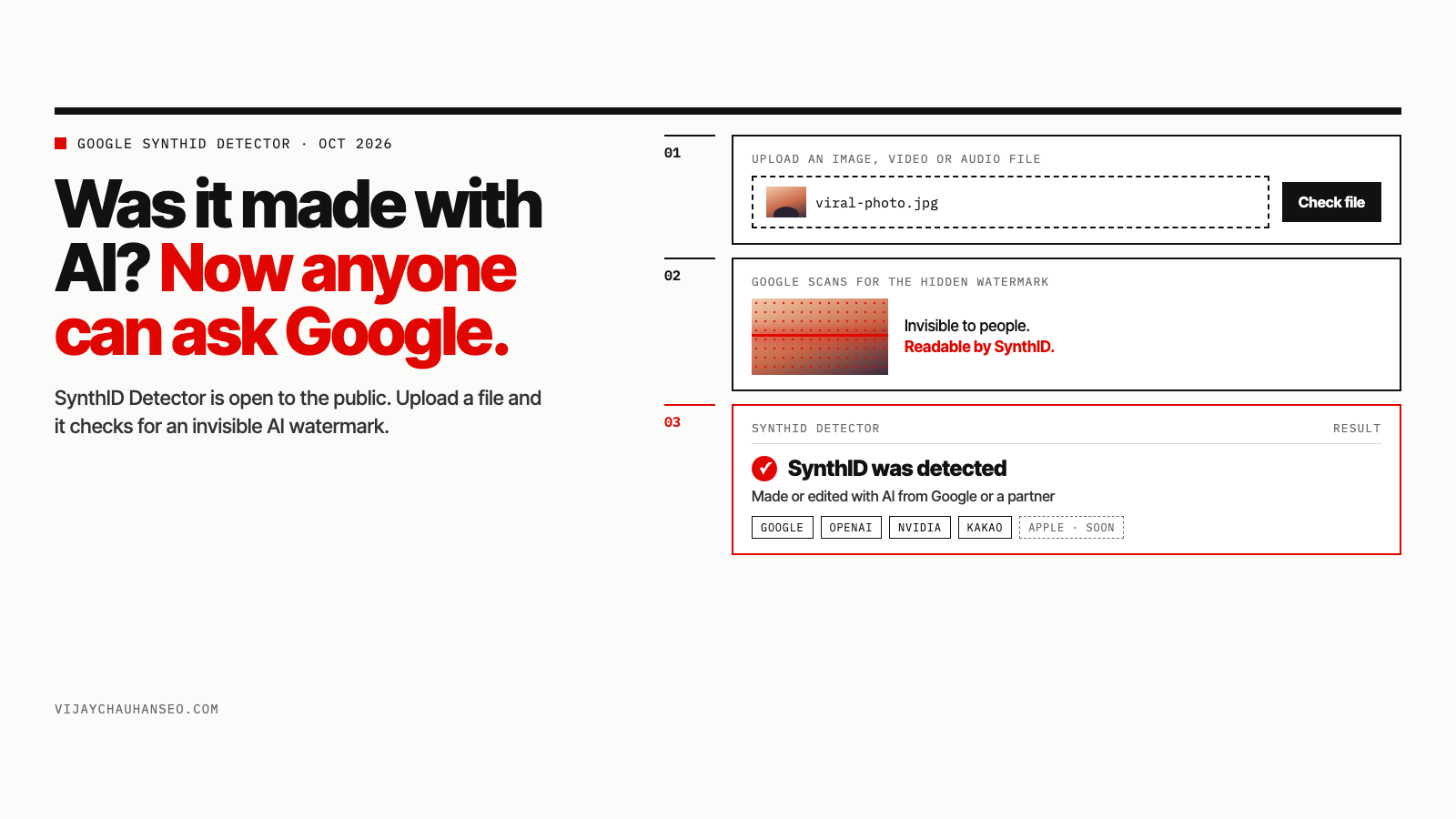
Seen an image online and wondered whether AI made it? Now you can ask Google. Google has opened SynthID Detector to the public. Anyone can upload an image, video or audio file at synthid.com and find out whether it carries SynthID, the invisible watermark Google and its partners add to AI-generated media.
Pushmeet Kohli, VP of Science and Strategic Initiatives at Google DeepMind, announced the expansion on October 7, 2026. The detector is available worldwide, in English.
What changed
Google first showed SynthID Detector in May 2025, but only journalists, media professionals and researchers could use it, and they had to join a waitlist. That waitlist is gone. Anyone can now use the tool for free.
According to Engadget, you need to sign in with a Google, OpenAI or Apple account to use it.
What SynthID Detector checks
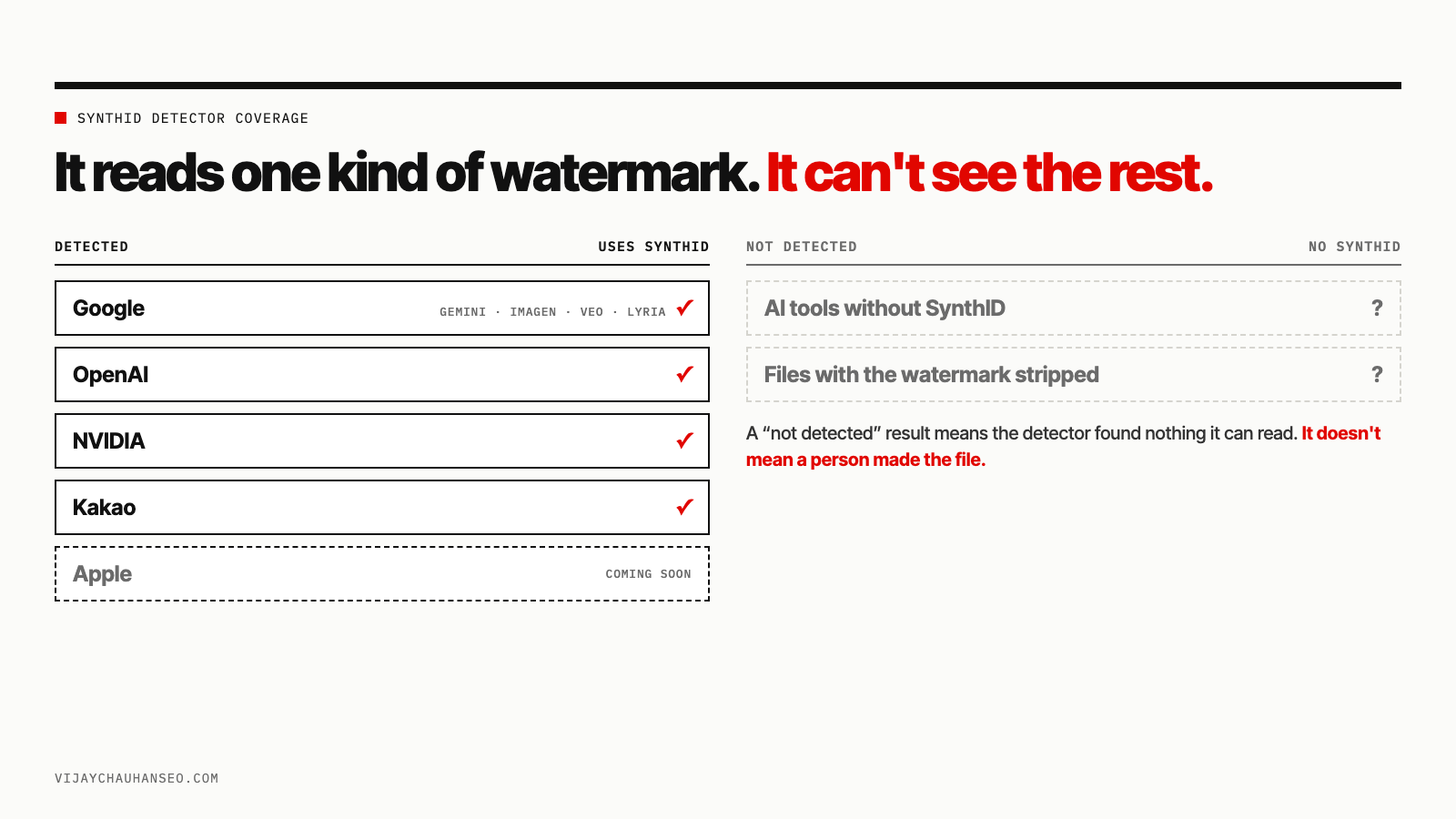
The detector looks for one thing: a SynthID watermark. SynthID is a signal hidden inside a file when it's created with a supported AI tool. You can't see it in an image or hear it in an audio clip, but the detector can pick it up.
It works on three kinds of files:
- Images
- Video
- Audio
And it covers media from these companies:
- Google, including Gemini, Imagen, Veo and Lyria
- OpenAI
- NVIDIA
- Kakao
- Apple, listed as "coming soon," with no date yet
That partner list is the big change. A Google-only detector was of limited use. A detector that also catches media from OpenAI's tools covers a far bigger share of the AI images people actually share.
How to use it
- Go to synthid.com and sign in.
- Upload the image, video or audio file you want to check.
- Read the result.
Google recommends uploading the best-quality copy you have. A file that's been compressed, screenshotted or re-saved several times gives the detector less to work with.
How to read the result
This is where most people will trip up, so it's worth being precise.
If SynthID is found, the result says "SynthID was detected" and that the media "was made or edited with Google AI." It may also warn that the file could have been changed since then.
Notice the words made or edited. A real photo that someone retouched with an AI editing tool can get the same result as an image created entirely from a text prompt. So a positive result tells you AI touched the file. It doesn't tell you how much.
If SynthID isn't found, that does not mean a person made it. The file could come from an AI company that doesn't use SynthID. The watermark could also have been stripped out, which Engadget notes is possible in some cases.
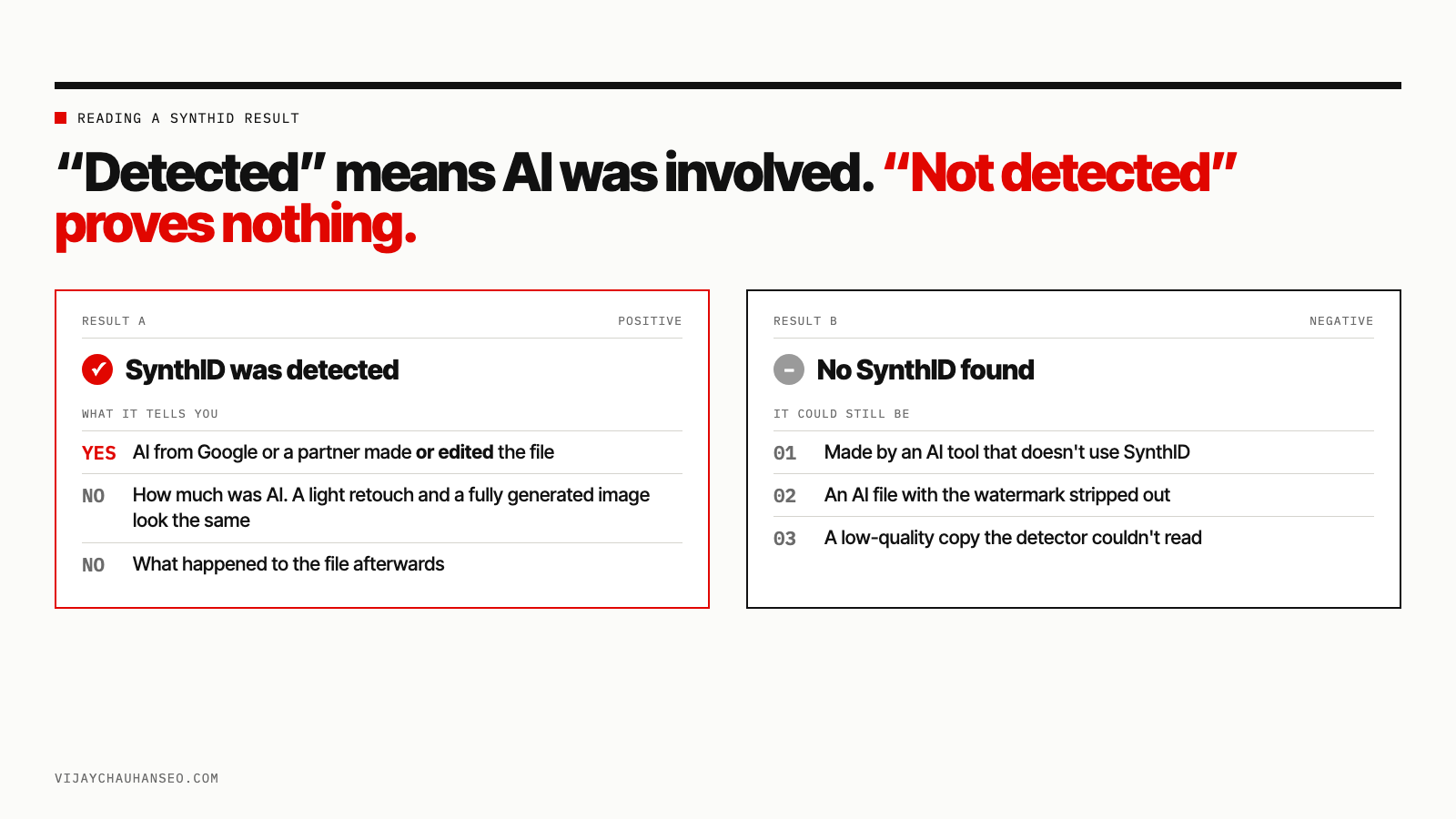
Google's own FAQ is upfront about this: "no signal is completely robust." It advises collecting several pieces of evidence before deciding whether something is real.
This isn't a general AI detector
It's easy to misread this launch as "Google can now spot any AI image." It can't. SynthID Detector only finds media from companies that have adopted SynthID. If a company uses a different system, or no watermark at all, the detector won't see it.
Think of it as a scanner that reads one brand of barcode. It's very good at reading that barcode, but it can't tell you anything about products that don't have one.
How big SynthID has become
SynthID is no longer a small experiment. According to figures reported by The Next Web, Google says it has watermarked more than 180 billion images and videos since 2023, along with 240,000 years of audio. SynthID checks inside Search, the Gemini app and Chrome handle more than one million requests a day.
Partner adoption is what really makes it count. NVIDIA added SynthID to its Cosmos models, and OpenAI, Kakao and ElevenLabs announced their adoption at Google I/O in May 2026.
Why it matters for SEO and content teams
Check before you publish. If your team uses stock images, user-submitted photos or visuals from freelancers, you can now quickly check whether any of them came from a SynthID-enabled AI tool. That's useful if your brand has a policy on AI imagery, or if you need to label AI content.
Don't panic about AI images in Search. Google's long-standing position is that using AI to make content isn't against its guidelines. What matters is whether the content is helpful and not made mainly to manipulate rankings. A SynthID watermark on your featured image isn't a ranking penalty.
Be honest about AI visuals. Readers, journalists and fact-checkers now have a free, easy way to check your images. If you pass off an AI image as a real photo, especially in news, reviews or product content, you're more likely to get caught, and that damages trust far more than any label would.
Expect provenance to show up in more places. SynthID checks already run in Search, the Gemini app and Chrome. As more AI companies adopt it, provenance information is likely to sit closer to search results, so where an image came from will matter more.
What we don't know yet
- When Apple support arrives. Google only says "soon."
- Whether more languages are coming. The launch is English only.
- Which other AI companies will join. The detector is only as useful as its partner list, and many popular image tools aren't on it.
- How well it handles heavily edited files. Google admits no signal is fully robust, but hasn't published accuracy figures for the public tool.
FAQ
What is SynthID Detector?
It's a free Google tool at synthid.com that checks images, video and audio files for SynthID, an invisible watermark added by AI tools from Google and partners including OpenAI, NVIDIA and Kakao.
Can SynthID Detector tell if any image is AI-generated?
No. It only detects media from companies that use SynthID. Content from other AI tools won't be flagged, so a "not detected" result doesn't prove a file is human-made.
Is SynthID Detector free?
Yes. It's free to use, though you need to sign in with a Google, OpenAI or Apple account, according to Engadget.
Will a SynthID watermark hurt my rankings?
There's no sign it will. Google's guidance says using AI to create content isn't against its rules. What matters is whether the content is helpful and original.
Sources: Search Engine Journal (Oct 2026); The Next Web (Oct 7, 2026); Google DeepMind: SynthID.
Run any page through the free GEO Content Analyzer and see how well it is structured for AI Overviews, AI Mode and LLM citations.
Analyze my content